


Key Takeaways for Busy Parents
Motor Planning and Executive Attention Share Neural Circuits: Developmental neuroscience demonstrates that the brain regions responsible for complex motor sequencing (the cerebellum) and cognitive planning (the prefrontal cortex) develop together and co-activate during novel physical challenges.
Movement Feeds Sensory Integration: In occupational therapy frameworks, whole-body movement provides intensive proprioceptive input (pressure in joints and muscles) and vestibular stimulation (balance and spatial orientation), helping children build internal body maps that support physical stability and calm.
WHO Guidelines Require 180 Minutes of Daily Movement: The World Health Organization recommends that preschoolers accumulate at least 180 minutes of physical activity daily across all intensities, including at least 60 minutes of energetic, moderate-to-vigorous play.
Safe Challenges Foster Risk Competence: Evolutionary psychologists hypothesize that navigating thrilling physical heights within safe, hazard-free boundaries allows children to practice objective risk appraisal and overcome physical hesitation.
No Climbing Area is Risk-Free: Providing indoor climbing equipment offers a dedicated physical outlet, but it requires strict safety engineering: mandatory structural wall-anchoring into masonry, certified impact-absorbing foam mats (at least 10–15 cm thick) over hard floors, and attentive adult supervision.
What the Scientific Research Actually Says
For decades, popular culture treated physical activity as mere exercise for muscles, while viewing desk work as the only real vehicle for cognitive development. Contemporary developmental science reveals a far more interconnected reality:
1. The Cerebellar-Prefrontal Axis: Movement as Cognitive Construction
In a seminal neurodevelopmental review published in Child Development, Dr. Adele Diamond synthesized neuro-imaging, anatomical, and behavioral evidence to examine the relationship between motor control and cognitive development.
Her analysis demonstrated that motor development and cognitive development are structurally and functionally intertwined :
The neocerebellum (traditionally viewed purely as an engine for motor timing, dynamic balance, and coordination) and the dorsolateral prefrontal cortex (responsible for working memory, selective attention, and goal planning) activate in close unison.
When a task is novel and demands focused planning—such as figuring out where to place a hand or foot on an unfamiliar climbing structure—both the cerebellum and the prefrontal cortex are recruited simultaneously.
Scientific Accuracy Note: Diamond's research explains the shared neurobiology of motor and cognitive planning. However, parents should be wary of exaggerated commercial marketing: no scientific study has ever proven that indoor climbing walls directly "boost IQ" or improve academic reading scores in toddlers. What gross-motor movement realistically provides is the foundational core strength, bilateral coordination, and attentional stamina necessary for future classroom tasks.
2. Sensory Integration: Understanding Proprioception and Balance
In her foundational work on child development, occupational therapist and neuroscientist Dr. A. Jean Ayres formulated Sensory Integration Theory. She identified two primary "hidden" sensory systems that operate below conscious awareness:
The Proprioceptive System: Receptors embedded in muscles, tendons, and joints that inform the brain about limb position, muscle tension, and gravitational force.
The Vestibular System: Fluid-filled canals in the inner ear that register motion, spatial acceleration, head position, and balance.
When a child crawls through a tunnel, pulls their body weight up a wooden ladder, or hangs from an overhead bar, their musculoskeletal system experiences what pediatric therapists call "heavy work"—deep proprioceptive compression.
Many pediatric occupational therapists observe that heavy work has a naturally grounding, stabilizing effect on young children, helping to discharge accumulated physical tension and reduce restlessness.
Important Medical Caveat: While sensory-rich movement is valuable for every child, the American Academy of Pediatrics (AAP) explicitly advises that sensory integration frameworks should be viewed as supportive developmental activities, not as a guaranteed medical cure for behavioral disorders or emotional dysregulation.
3. The Risky Play Paradox: Differentiating Hazards from Challenges
Why do children instinctively seek out heights and physical thrills?
In an evolutionary review published in Evolutionary Psychology, Ellen Sandseter and Leif Kennair proposed that thrilling physical play involving heights and speed functions as an evolutionary anti-phobic mechanism. They hypothesized that when young children gradually confront thrilling physical challenges within safe limits, they learn to habituate to fearful sensations, develop objective risk appraisal, and build emotional confidence.
This hypothesis is supported by a comprehensive systematic review published in the International Journal of Environmental Research and Public Health by Dr. Mariana Brussoni and colleagues. Evaluating 21 international studies on risky outdoor play, the researchers found that children who had opportunities to navigate challenging physical environments exhibited:
Significantly higher levels of daily physical activity.
Improved motor competence, balance, and spatial navigation.
Enhanced social problem-solving and emotional resilience.
An exceptionally low rate of catastrophic or severe injuries, provided the physical environment eliminated hidden hazards.
Motor Affordance Calibration in Early Childhood
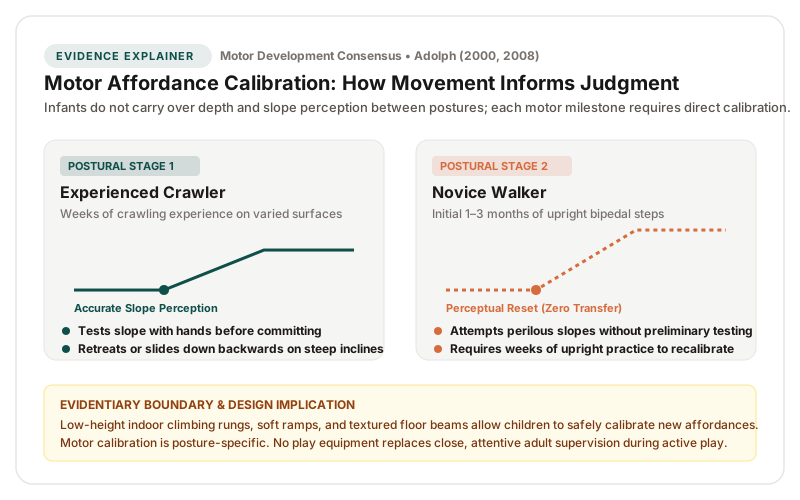
Karen Adolph (2000, 2008): Motor learning is posture-specific. Active, self-initiated exploration calibrates physical risk judgment.
What the Findings Mean for Children
When a child has access to safe, authorized physical movement affordances, they experience several tangible developmental benefits:
Core Postural Strength: Climbing, crawling, and hanging develop the core abdominal, shoulder girdle, and back musculature. A child with solid core stability can sit comfortably upright at a desk later in school without slouching, leaning on their elbows, or constantly fidgeting.
Bilateral Coordination & Midline Crossing: Scaling a climbing ladder requires alternating contralateral movement—using the right hand with the left foot, and vice-versa. Crossing the physical midline of the body exercises neural communication across the corpus callosum, supporting visual-motor integration.
Sound Nighttime Sleep: Meeting the WHO's physical activity benchmark (at least 60 minutes of energetic moderate-to-vigorous play) allows children to burn physical energy constructively, leading to smoother sleep onset and deeper, uninterrupted night sleep.
What the Findings Mean for Parents
Ending the Constant "Don't Climb That!" Battles: When children have a dedicated, purpose-built climbing structure with certified fall mats, parents can stop acting as full-time safety wardens. Instead of shouting when a child scales a table, you can redirect them calmly: "The dining table is for eating; if you want to climb, use your climbing ladder."
Weather-Proof Indoor Peace of Mind: Urban Indian families regularly endure 45°C summer heatwaves in Delhi, torrential monsoon rains in Mumbai, or hazardous seasonal smog across North India. During these months, public parks are inaccessible. An indoor movement zone ensures children meet their daily physical activity needs safely indoors.
A Calmer Home Environment: Physical movement acts as a natural pressure-release valve. Children who have spent 20 to 30 minutes climbing and balancing indoors are measurably more cooperative, focused, and calm during family routines and mealtimes.
Practical Environmental Strategies: Designing an Indoor Movement Zone
You do not need a commercial gymnasium to bring the benefits of movement science into an apartment. A dedicated 6x4-foot footprint along an unused wall can become an active movement haven:
1. The Space-Efficient Swedish Wall Ladder
The classic wooden Swedish wall ladder (wall bars) is the most space-efficient indoor gross-motor fixture available.
Mounted vertically flush against a solid brick or concrete wall, it projects only 6 to 8 inches into the room, preserving open floor space.
The rungs provide progressive, self-limiting physical challenges: a toddler can pull up on the lowest rungs, while a five-year-old scales higher, practicing foot placement and grip strength.
2. High-Density Dual-Layer Fall Mats
In Indian apartments, floors are almost universally constructed from unyielding vitrified tile, granite, or marble. Installing climbing equipment over bare stone is an unacceptable physical hazard.
Always install a certified, high-density impact-attenuation mat (at least 10–15 cm thick) beneath any climbing zone, conforming to EN 1176 or ASTM F1292 standards.
High-density foam also serves an essential social purpose: it absorbs kinetic vibrations, dampening the thumping sound of jumping and preventing noise complaints from neighbors living in the flat below.
3. Dynamic Balance Elements
Incorporate low-to-the-ground balance equipment that can be moved or stored easily:
A curved wooden wobble/balance board (which doubles as a rocking seat, bridge, or slide).
A low wooden balance beam placed 4 to 6 inches above the floor to practice foot stability and spatial awareness.
4. Overhang Hanging Affordances
If space permits, install a top overhang rung or adjustable wooden gymnastic rings. Hanging by the hands decompresses the spine, builds shoulder girdle stability, and strengthens palmar grip—the exact physical foundation required later for comfortable, fatigue-free handwriting.
Age-Specific Considerations
Safety Engineering: Eliminating Hazards While Protecting Challenges
True developmental movement requires maintaining a strict distinction between hazards and challenges :
Eliminate All Engineered Hazards:
Secure every wall-mounted structure directly into solid concrete or brick masonry using heavy-duty industrial expansion bolts. Never mount climbing equipment into hollow drywall or false gypsum partitions.
Inspect wooden rungs periodically for splinters, structural cracks, or loose hardware.
Maintain a 1.5-meter safety perimeter around all climbing zones, completely clear of sharp furniture corners, glass tables, or door swings.
Protect the Developmental Challenge:
Once the environment is physically safe (with certified crash pads and solid wall anchors), step back.
Never lift a child onto a climbing rung they cannot reach themselves. If a child cannot reach a rung independently, their motor system and risk appraisal are not yet ready to manage that height safely. Self-initiated climbing is naturally self-limiting.
Indoor Climbing Safety: Fall Zones & Mechanical Anchoring
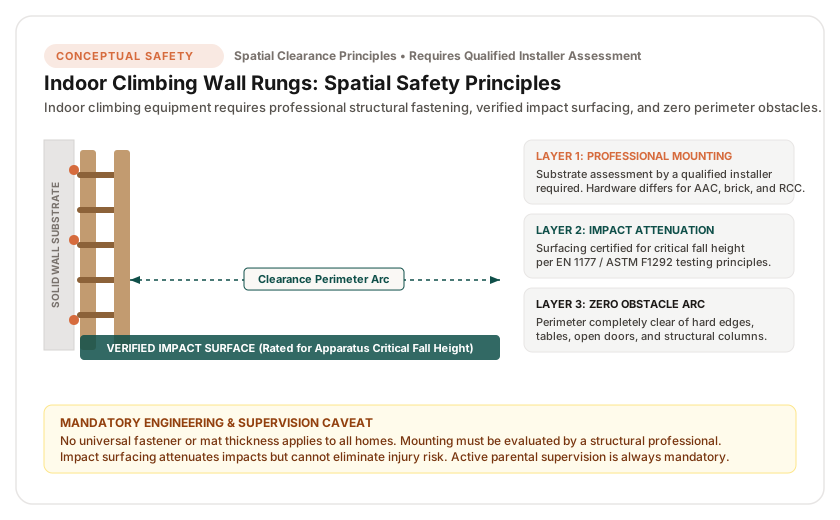
Safety Architecture: Residential indoor climbing requires structural wall fastening into masonry, 1.5m clearance, and high-density impact mats.
Limitations of the Scientific Evidence
Movement is an Enabler, Not an Academic Guarantee: While gross-motor coordination supports attentional stamina and core strength, it does not replace high-quality literacy instruction or loving relational care.
No Room is Risk-Free: Providing an indoor movement area does not mean accidents are impossible. Minor bumps and bruises are part of normal motor learning; parental passive supervision remains essential for young children.
Frequently Asked Questions
Won't having climbing bars inside the house encourage my child to jump off other furniture?
Observational evidence shows the opposite. When children have no legitimate physical outlet for their biological movement drive, that energy erupts destructively—jumping off dining tables or scaling bookcases. Providing a designated climbing apparatus allows parents to set clear, consistent boundaries: "Climbing belongs on your wall ladder over the mat; furniture is for sitting."
We have hard Italian marble floors in our flat. Can indoor climbing ever be truly safe?
Yes, provided you adhere to certified impact-attenuation standards. Safety on hard stone flooring is determined entirely by the quality of the crash mat. Installing a dual-layer, high-density foam mat (at least 10–15 cm thick) certified to EN 1176 or ASTM F1292 standards absorbs fall kinetic energy, protecting developing joints and bones.
What if my child is hesitant, cautious, and afraid of climbing?
Never push, pull, or force a hesitant child onto a climbing structure. Forced exposure causes distress, not confidence. Instead, celebrate small micro-steps: placing one hand on a low rung, hanging for two seconds from a low bar, or crawling across a low floor beam. When the environment is permanent and pressure-free, children naturally expand their boundaries at their own neurobiological pace.
Related Kubeplay Parents Corner Articles
Movement Before Screens: The Kubeplay Way
At Kubeplay, our core philosophy is simple: Safe by design, movement before screens, crafted for families. We engineer indoor climbing gyms, Swedish wall bars, balance systems, and certified impact-attenuating play environments that integrate seamlessly into modern Indian apartments—giving children the safe, joyful physical outlets they need to thrive. Explore movement-first children's spaces at kubeplay.com.
Children do not climb to defy us; they climb to build their brains. When we provide a safe, authorized place to climb, we transform a domestic hazard into a foundation of physical confidence.
Related to this topic
Designing a space for play, movement and learning?
Kubeplay's interior-design services cover children's bedrooms, playrooms and study spaces.
Explore Kubeplay children's-space servicesFurniture ideas for the room
Explore category guidance and bespoke design options. Individual product availability is confirmed separately.