


Key Takeaways for Busy Parents
No Direct Playroom Trials Exist: There is no direct experimental evidence proving that redesigning a playroom will independently reduce screen time. Space design is an enabling condition, not a standalone medical or behavioral cure.
Private Screen Access Correlates with Higher Media Use: Longitudinal observational studies in school-aged children and adolescents reveal that having screens in private bedrooms is strongly associated with higher daily media use (between 45 minutes and two hours more per day compared to peers without bedroom screens).
Fewer Toys Support Deeper Attention: Controlled laboratory experiments show that toddlers presented with 4 toys rather than 16 toys engage in significantly longer, deeper, and more creative play per toy (p < 0.001). While this trial did not study screens, reducing toy clutter may prevent the fragmented attention that prompts parents to offer a device.
Parental Habits Outweigh Interior Design: Systematic reviews demonstrate that parental media modeling, family rules, and background television exposure are far stronger predictors of preschool screen time than any physical room feature.
Young Children Learn Best Through 3D Manipulation: Pediatric evidence confirms a developmental "video deficit"—children under five struggle to translate 2D digital content into real-world conceptual mastery compared to what they absorb through three-dimensional, hands-on exploration.
What the Scientific Research Actually Says
To understand the relationship between physical space and digital media, developmental researchers study how children interact with their immediate physical surroundings—a context developmental psychologist Urie Bronfenbrenner termed the child's microsystem.
1. Private Screens and Media Habits: The Bedroom Media Effect
In a landmark prospective longitudinal study published in Developmental Psychology, researchers tracked 3,034 children in Singapore across two years to evaluate the developmental associations of private media access. The researchers found that children with televisions or game consoles in their private bedrooms accumulated substantially more weekly screen time (an average of 1.4 to 2.1 hours more per week) and exhibited lower school grades over time compared to peers without bedroom media.
Similarly, in a prospective cohort study published in the International Journal of Behavioral Nutrition and Physical Activity, Atkin and colleagues followed 444 children from age 10 to age 14. Having a television in the bedroom at age 10 was longitudinally associated with an additional 48.2 minutes per day of screen time for boys at age 14.
It is vital, however, to interpret these findings with scientific precision:
These studies were observational and correlational, not experimental room-removal trials.
The participants were older school-aged children and adolescents (mean ages 11–14), not toddlers or preschoolers.
Having a screen in a private room often reflects broader household norms, such as more permissive media rules or higher overall parental screen time.
Nevertheless, the behavioral mechanism is grounded in environmental friction. When a television or tablet is stationed directly within a child's private sanctuary, accessing digital entertainment requires zero physical effort and occurs outside parental line-of-sight. When screens are physically removed from private areas and restricted to communal family zones, accessing media requires intentional adult engagement.
2. The Toy Density Experiment: Why More Toys Does Not Mean Better Play
Many parents assume that filling a playroom with dozens of diverse toys will keep a child entertained and away from screens. Yet, developmental science demonstrates that toy saturation can backfire.
In a carefully controlled within-subject laboratory experiment published in Infant Behavior and Development, researchers placed 36 typically developing toddlers (aged 18–30 months) in standardized playrooms under two distinct conditions: an environment with 4 toys versus an environment with 16 toys.
The findings were striking:
In the 4-toy environment, toddlers played with each toy for a significantly longer duration (M = 92.4 seconds vs. M = 48.6 seconds per interaction, t(35) = 5.82, p < 0.001, Cohen's d = 1.34).
Toddlers in the 4-toy condition demonstrated a greater variety of exploratory manners (M = 4.8 vs. M = 2.6 manners, p < 0.001), engaging in more sophisticated, imaginative play schemas.
In the 16-toy condition, toddlers switched toys twice as frequently (M = 28.4 switches in 30 minutes vs. M = 14.2 switches, p < 0.001), displaying superficial, fragmented attention.
Crucial Scientific Distinction: Dauch and colleagues evaluated toddler play mechanics and toy density in a controlled laboratory setting; they did not measure digital screens, cognitive intelligence/IQ, or parental leisure time. Furthermore, the study tested loose toys, not interior room design or commercial furniture.
However, child development specialists draw a reasonable inference: when a child's play space is saturated with overflowing toy baskets, the visual clutter can overwhelm immature selective attention. The child flits rapidly between toys, becomes irritable, and appears "bored"—leading fatigued parents to resort to a digital device. Curating a smaller number of accessible toys supports deeper, sustained engagement.
Overfilled Toy Bins
16+ toys accessible
Fragmented Attention & Rapid Toy Switching
Superficial Restlessness
“Mama, I’m bored!”
Parent Offers a Tablet
To restore calm
Screen-Time Reinforcement
More screen time and sedentary habits
Evidence context: Dauch et al. (2018)
3. The Limits of Space: Parental Modeling Outweighs Room Design
Can a beautifully designed playroom overcome heavy digital media habits? The empirical literature says no.
In an exhaustive systematic review published in BMC Public Health, Choi and colleagues analyzed 52 international studies examining the factors that determine whether preschoolers meet World Health Organization screen time guidelines (<1 hour per day).
Their findings provide a necessary reality check for interior design claims:
While physical environmental factors (such as device visibility and private screen access) play an enabling role, parental screen time, parental media rules, and background television exposure are the dominant determinants of preschool screen consumption.
A child whose parents frequently use smartphones in the play area or leave the living room television on as background noise will consume high levels of media, regardless of how well their playroom is designed.
Physical space is an affordance—it makes certain behaviors easier or harder—but it operates in strict synergy with parental boundaries, not as an independent cure.
The Developmental Mechanisms: Why Hands-On Play Matters
Why does the American Academy of Pediatrics (AAP) recommend keeping children's play areas screen-free and prioritizing hands-on play ? The reason lies in early sensory-motor neurodevelopment.
The Pediatric "Video Deficit"
During the first five years of life, the brain develops through multisensory feedback—integrating touch, weight, balance, spatial resistance, and social cues simultaneously. Developmental psychologists have repeatedly demonstrated that young children experience a "video deficit": they struggle to transfer two-dimensional representations seen on a flat screen into real-world conceptual understanding.
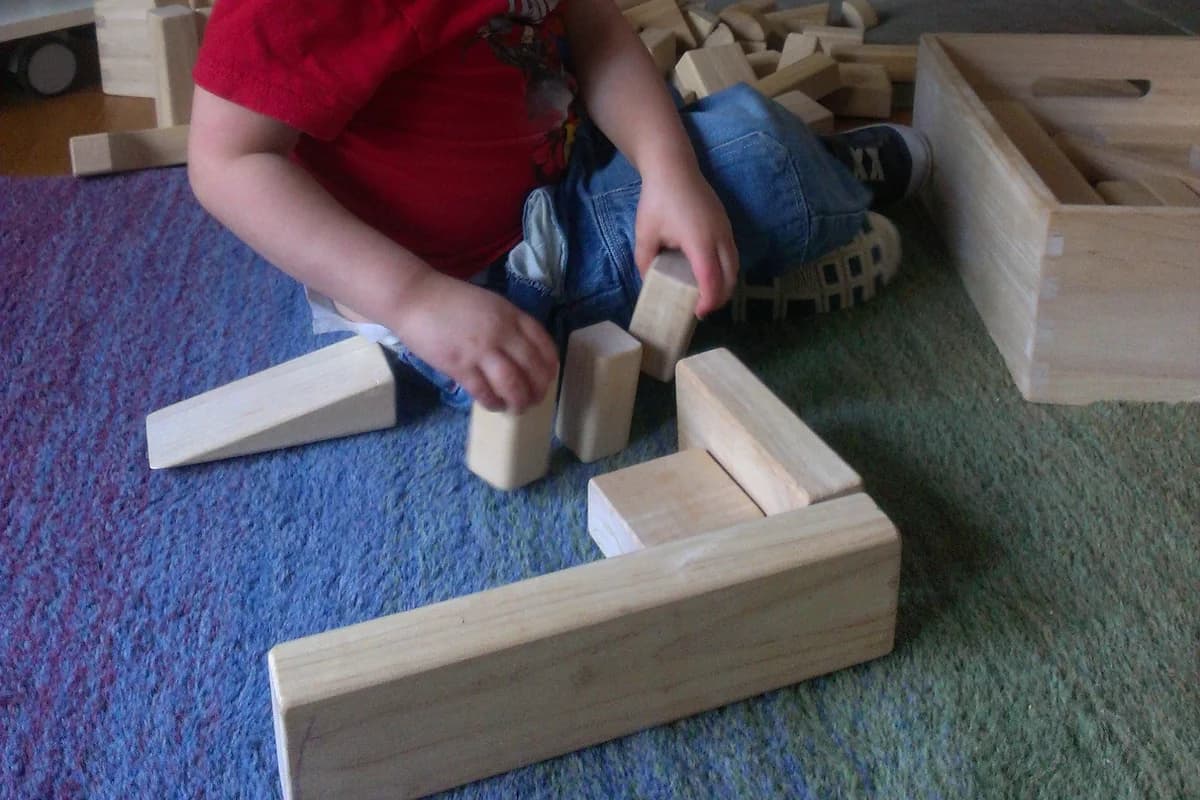
A digital block on an iPad makes a chiming sound when tapped, but it has no mass, no gravitational center, no physical friction, and no tactile texture. Stacking real wooden blocks, balancing on a low wooden beam, or moulding real clay demands complex hand-eye coordination, proprioceptive feedback (muscle pressure), and spatial reasoning that flat screens cannot deliver.
Environmental Choice Architecture
Children do not choose their leisure activities through long-term rational planning; they respond to immediate environmental cues. If art paper and blocks are locked behind high cabinet doors while an iPad sits on the low living room coffee table, the child will naturally reach for the iPad.
By applying behavioral choice architecture—storing screens entirely out of sight and displaying open-ended physical materials at child eye-level—parents reverse this friction. Real-world play becomes the path of least resistance.
What the Findings Mean for Children
When a home environment provides an accessible, screen-free physical play zone, children experience tangible developmental opportunities:
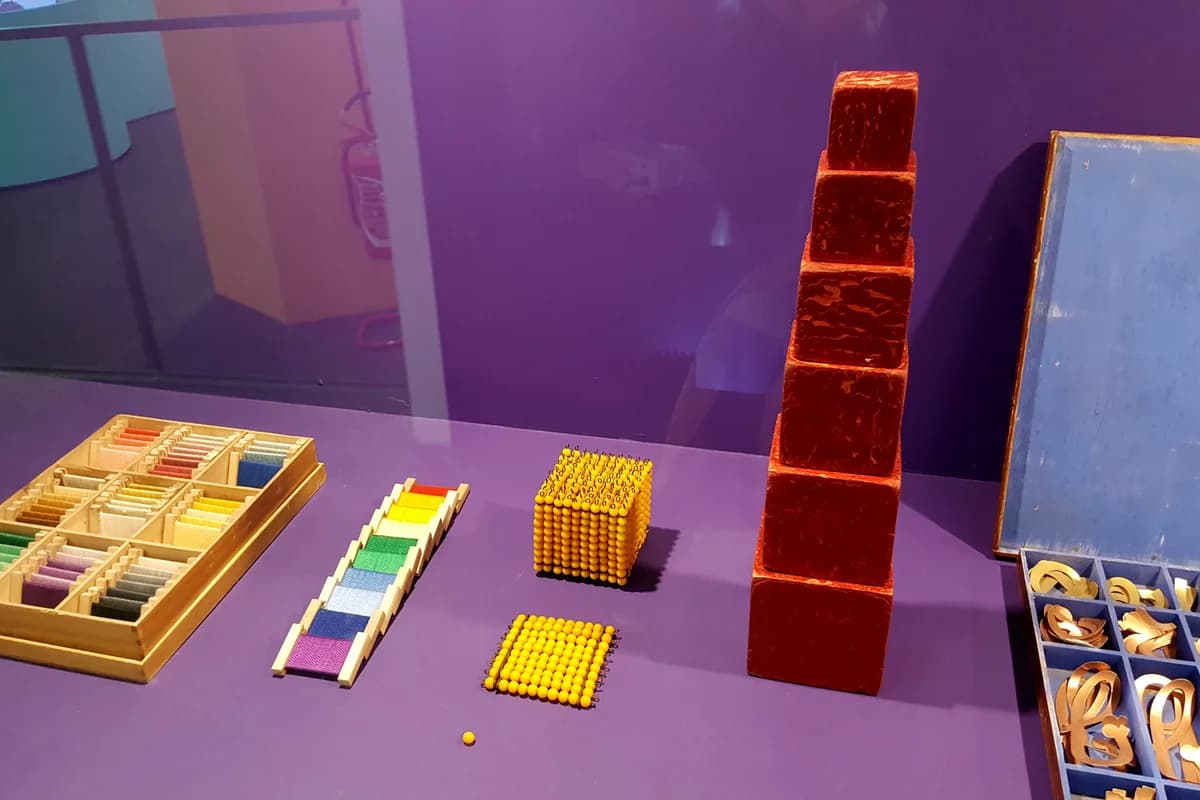
Prolonged Play Immersion: Free from the sensory distraction of screens and the overwhelm of excessive toys, children have the physical setting needed to enter deeper, more sustained play bouts.
Gross and Fine Motor Practice: In urban Indian apartments where outdoor access is often limited by traffic, extreme heat, or monsoon rains, an indoor movement corner allows children to meet their physiological movement needs through crawling, climbing, and balancing.
Emotional Grounding: Tactile manipulation of open-ended materials (blocks, clay, construction pieces) allows children to express internal narratives and discharge physical restlessness naturally.
What the Findings Mean for Parents
Reduced Daily Screen Friction: Removing screens from children's personal bedrooms and play areas establishes a clear physical boundary. The constant whining and bargaining for "just five more minutes" diminishes because the screen is simply not present in their daily space.
Opportunities for Personal Rest: When children develop the capacity to engage in deeper, self-directed physical play, parents gain reliable intervals of 20 to 45 minutes to finish work, read, or rest without feeling pressured to act as a 24/7 entertainer.
Freedom from Guilt: Recognizing that toy clutter causes superficial attention allows parents to stop feeling guilty about not buying every new toy on the market. Fewer, higher-quality open-ended toys actually support better play.
Practical Environmental Design Suggestions for Indian Homes
You do not need a spacious suburban villa to apply the principles of environmental psychology. Even within a compact 2BHK or 3BHK flat in Mumbai, Bengaluru, or Delhi-NCR, these four evidence-informed principles can transform your space:
1. The Screen-Sightline Rule
Ensure that your child's primary play area does not have a television or computer monitor in its direct line of sight. If your living room serves as the play area, arrange low shelving or play mats so that the child faces away from the television screen. Store tablets and smartphones in closed overhead drawers outside the child's reach.
2. Implement the "Rule of Four" Toy Rotation
Drawing on the findings of Dauch and colleagues, remove overflowing plastic toy bins. Instead, install low, child-height open shelves that display only 4 to 6 curated open-ended items at any given time (for example: a basket of wooden unit blocks, a set of animal figurines, wooden vehicles, and drawing paper). Keep the remainder in a closed closet, rotating items every two weeks to renew novelty without clutter.
3. Build an Indoor Gross-Motor Anchor
Indian city living frequently restricts daily park visits due to weather or pollution. Dedicate one wall or corner of the room to physical movement:
A compact wooden Swedish ladder (wall bars) for vertical climbing.
A low wooden balance beam or stepping stones laid across the rug.
High-density foam crash mats underneath to absorb impacts and dampen jumping vibrations for downstairs neighbors.
4. Protect Floor "Negative Space"
Resist the temptation to fill every square foot with storage units. Children need open, unobstructed floor space to crawl, roll, build sprawling tracks, and act out imaginative stories. A clean, non-toxic cotton or wool floor rug defining the play boundary is often the most effective design element.
Toy Quantity vs. Toddler Play Quality
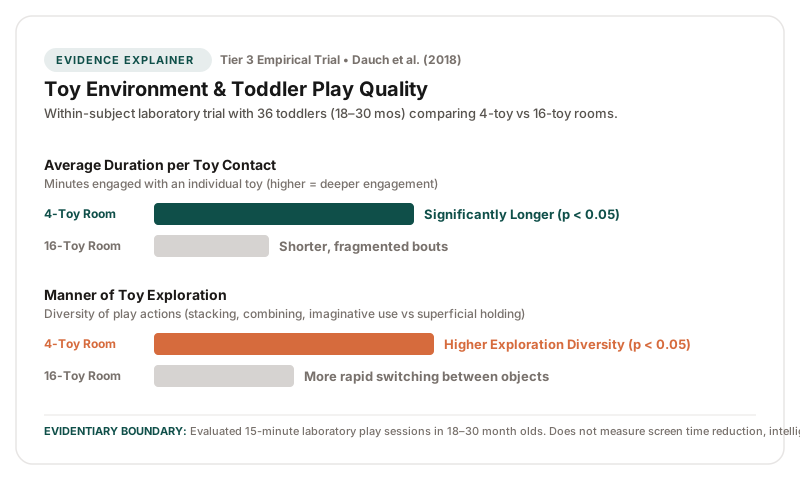
Laboratory findings from Dauch et al. (2018): Toddlers in 4-toy environments engaged in significantly longer play bouts and explored toys in more varied, creative ways.
Age-Specific Considerations
Safety Considerations for Indoor Play Environments
Creating an active indoor play space requires strict adherence to physical safety:
Mandatory Furniture Anchoring: Every shelf, bookcase, and climbing structure must be structurally anchored into concrete or brick masonry walls using heavy-duty hardware to eliminate tip-over risks (conforming to ASTM F2057 or relevant BIS standards).
Certified Fall Protection: Never install climbing equipment over bare granite, vitrified tile, or marble flooring. Always station certified, high-density, dual-layer foam impact mats beneath climbing zones.
Non-Toxic Finishes: Ensure all wooden furniture and play equipment are treated with child-safe, zero-VOC water-based sealants or natural oils, particularly in homes with young children who explore objects orally.
Limitations of the Scientific Evidence
To maintain complete transparency, parents should bear in mind:
No Direct Interventions: Research has not evaluated whether building a custom playroom directly causes screen time to fall. Room design is an environmental facilitator, not an independent causal agent.
Parental Modeling Dominates: An expensive playroom will fail to reduce screen time if parents are constantly on their phones in front of the child or use television as background noise.
Cultural and Space Realities: In dense Indian cities, many families share bedrooms with grandparents or siblings. Dedicated playrooms are often physically impossible; however, functional micro-zoning within a shared living area can achieve the same behavioral affordance.
Frequently Asked Questions
We live in a 2BHK flat in Mumbai. Do we really need an entire separate playroom?
No. The psychological principles of environmental affordances apply to corners and zones, not entire rooms. A 4x4-foot dedicated play corner in a bedroom or living room—equipped with a low shelf displaying four toys, a textured rug, and a climbing bar—provides the exact same developmental affordance as an expansive standalone room.
What if my child still begs for the tablet even in a beautifully organized play corner?
Digital media stimulates rapid reward pathways that static toys cannot match instantaneously. When scaling back screen habits, expect 3 to 7 days of behavioral friction. Bridge this transition with parental connection: spend the first ten minutes sitting on the rug initiating a building project or obstacle course together, then gradually step back as their autonomous curiosity engages.
How often should we rotate toys to keep them engaging?
Rotating toys every two to three weeks is generally optimal. When old toys are brought back out of a closed closet after several weeks of absence, young children experience them with renewed curiosity and creative focus.
Related Kubeplay Parents Corner Articles
The Science of Children's Spaces: Why Sleep, Study and Play Zones Matter
The Screen-Free Childhood: How to Make Real-World Play More Appealing
Why Movement Matters: How Climbing, Balancing and Crawling Support Early Development
Purposeful Spaces for Childhood
At Kubeplay, we believe children's environments should be safe by design, prioritize movement before screens, and be crafted to make family life genuinely enjoyable. While no interior design feature can replace loving parental presence and consistent family rules, creating a home space that invites movement, creativity, and hands-on exploration makes choosing real-world play easier for every child. Explore our purposeful children's spaces at kubeplay.com.
A playroom does not cure screen dependency. But an environment that offers clear invitations to move, build and imagine makes the real world far more compelling than a glowing screen.
A Kubeplay connection
Spaces that nurture independent growth
At Kubeplay, we design children’s rooms that respect how children naturally move, play, rest and learn. Every piece of furniture, zoned boundary and accessible shelf is built with natural wood, non-toxic finishes and child-centred ergonomics.
Explore Kubeplay child space designs