


Key Takeaways for Busy Parents
A Design Framework Grounded in Basic Science: While room zoning has not been tested as a clinical therapy in pediatric trials, dividing spaces into dedicated functional zones draws directly on established principles of stimulus control, attention management, and sleep hygiene.
The Brain Relies on Stimulus Control: Behavioral sleep science demonstrates that environments become conditioned cues for physiological states. Reserving the bed strictly for sleep and quiet wind-down helps condition the brain for rest, whereas using the mattress for energetic play or screens can contribute to conditioned bedtime alertness.
Visual Clutter Diverts Young Children's Focus: In controlled laboratory experiments, kindergarteners taught in heavily decorated rooms spent nearly double the time off-task (28.4% vs. 16.0%, p < 0.001) and achieved lower learning scores than when taught in streamlined rooms with bare walls. Cognitive scientists suggest that shielding a child's study desk from visual play clutter similarly protects their immature working memory.
Predictable Routines Restore Family Calm: Clinical trials across thousands of families demonstrate that consistent, predictable bedtime routines (such as a bath, massage, and shared reading) significantly reduce sleep onset latency and improve maternal mental health within three nights.
Micro-Zoning Works in Small Apartments: You do not need a three-room flat to create purposeful zones. Thoughtful micro-zoning—using furniture orientation, directional lighting, and floor rugs—establishes functional neurological boundaries within a single 10x12 ft bedroom.
What the Scientific Research Actually Says
To evaluate the developmental value of spatial zoning, we must examine the primary scientific disciplines that inform it:
1. The Stimulus Control Principle: Why Bedtime Battles Happen
In clinical behavioral psychology, one of the most thoroughly validated frameworks is Stimulus Control Theory, pioneered by Dr. Richard Bootzin. The core biological premise is that physical environments acquire the conditioned properties of the activities that consistently occur within them.
When applied to sleep, sleep specialists emphasize that the bed and its immediate perimeter must serve as a discriminatory stimulus for parasympathetic de-arousal—the physiological state characterized by a slowed heart rate, reduced cortisol, and the release of natural melatonin.
If a child regularly uses their mattress to wrestle, play mobile games, jump, or complete stressful academic worksheets, the central nervous system conditions the bed as a setting for physiological wakefulness and alertness. When bedtime arrives and the parent says "it's time to sleep," the child's body is receiving conflicting biological signals. Their bed is screaming "alertness," making rapid sleep onset difficult.
Reserving the mattress exclusively for sleep and calming, low-arousal shared bedtime reading helps re-establish the bed as an unambiguous cue for sleep.
2. The Visual Clutter Experiment: Protecting Fragile Working Memory
When it is time for homework, reading, or drawing, why do young children find it so difficult to concentrate when sitting at a desk surrounded by toys?
A landmark laboratory experiment published in Psychological Science by researchers at Carnegie Mellon University evaluated this exact question in kindergarten-aged children. Children were taught structured science lessons under two physical conditions: a heavily decorated classroom (covered in educational posters, maps, and artwork) versus a streamlined, sparse classroom with bare walls.
The findings were definitive:
In the heavily decorated room, children spent 28.4% of their learning time off-task, repeatedly distracted by ambient visual stimuli.
In the streamlined room, off-task time dropped to 16.0% (p < 0.001).
Children in the streamlined space demonstrated significantly higher learning retention and test scores (55% vs. 42%, p < 0.001).
In a follow-up trial published in Cognitive Science, researchers demonstrated that children do not simply habituate to ambient visual distractions over time; clutter continues to capture attention across multiple weeks.
Important Methodological Translation: Fisher and colleagues evaluated classroom wall decorations, not home bedrooms or study desks. However, cognitive psychologists draw an evidence-informed inference: young children possess immature prefrontal inhibitory control. They cannot voluntarily ignore colorful toy baskets, climbing ladders, or action figures sitting in their direct line of sight. Shielding a study desk from visual play clutter removes competing stimuli from their limited working memory.
3. Bedtime Routines and Household Order: What Trials Actually Show
In a randomized controlled trial published in Sleep, Dr. Jodi Mindell and colleagues tested a standardized 3-step bedtime routine (bath, lotion/massage, and quiet cuddling/reading) in 405 mother-infant pairs.
The trial revealed that instituting a predictable, calm bedtime routine significantly reduced sleep onset latency, reduced nocturnal awakenings, and substantially improved maternal mood within just three nights. A subsequent cross-cultural study of 10,085 children across 14 countries confirmed a dose-dependent relationship between consistent bedtime habits and extended sleep duration.
Scientific Accuracy Note: Mindell's studies evaluated a behavioral routine, not architectural room zoning. However, environmental psychologists point out that physical space and behavioral routines work symbiotically. When an environment is structured so that quiet wind-down activities occur away from chaotic play clutter, maintaining that predictable routine becomes far easier for tired parents.
The Developmental Mechanisms: Supporting Three Distinct Brain States
Why does dividing a room into three functional zones make developmental sense? Because a child experiences three very different physiological states throughout the day, and each state benefits from specific environmental cues:
1. The Sleep Sanctuary (Parasympathetic Recovery)
The biological objective of the sleep zone is physiological down-regulation.
To support natural circadian rhythms, the sleep zone requires low, warm-spectrum lighting (under 2700 Kelvin) and the total absence of blue-spectrum screens, which suppress pineal melatonin secretion.
The bed should be protected from visual reminders of daytime obligations (school textbooks) or high-energy physical excitement (indoor climbing frames or loud toy bins).
When a child steps into this area, their sensory system receives an unambiguous cue: it is time to rest.
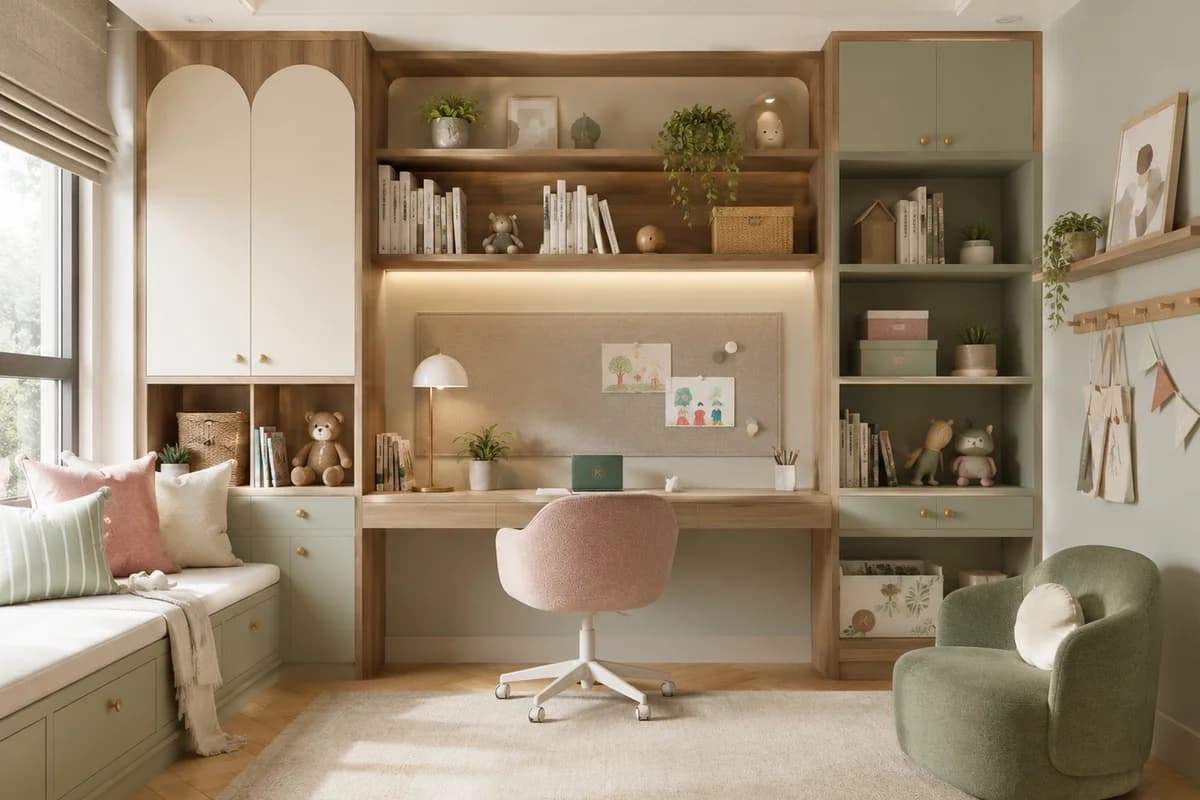
2. The Focus Station (Prefrontal Working Memory)
The cognitive goal of the study zone is distraction shielding.
Positioning a child's study desk so that it faces a clean wall or quiet window prevents visual play stimuli from invading their peripheral field of vision.
An ergonomic, child-scaled chair that provides solid foot support grounds the child's proprioceptive system, preventing the physical fidgeting that occurs when legs are left dangling in mid-air.
3. The Movement & Play Arena (Somatic Discharge)
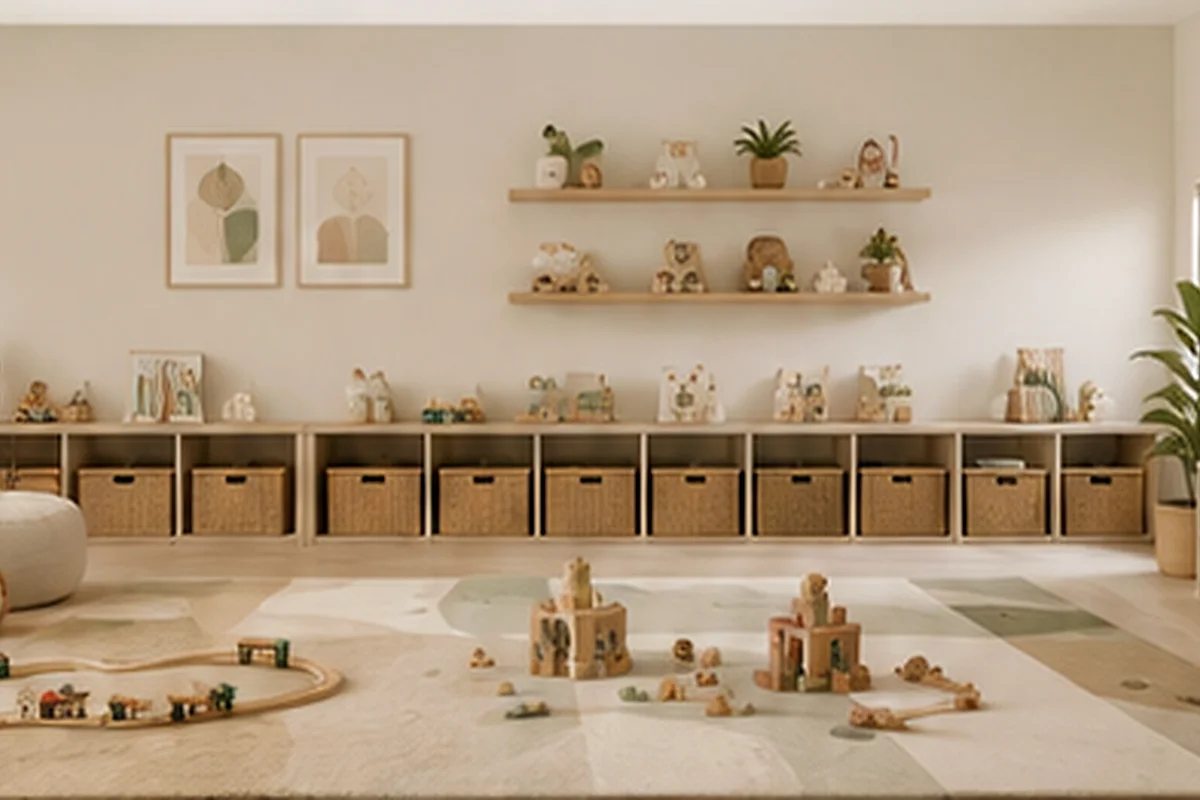
Children are biological organisms driven to move, build, and explore. The play zone provides an authorized arena for somatic energy discharge and creative expression.
By clearly demarcating this zone with a distinct floor rug or low shelving, children can engage in noisy, sprawling, energetic play without parents having to worry that toys will end up under the bedsheets or across the homework desk.
What the Framework Realistically Offers Children
When spaces provide clear, functional boundaries, children benefit in several tangible ways:
Predictable Transitions: Children thrive on environmental cues. When physical space signals what behavior is appropriate, children experience less confusion and anxiety during daily transitions.
Reduced Cognitive Fatigue: Sitting at a study desk that faces away from toy clutter allows children to complete reading and homework tasks with fewer off-task distractions.
Authorized Freedom to Play: In their designated play zone, children have full ownership. They can build, test, and create without an adult constantly hovering and warning them not to mess up the bed or study table.
What the Framework Realistically Offers Parents
Smoother Evening Transitions: Aligning your space with stimulus control principles and consistent bedtime routines helps children wind down faster, giving parents back precious evening hours to rest, converse, or read.
Reduced Homework Friction: When study spaces are shielded from visual play temptations, parents spend less energy repeatedly redirecting their child's attention back to their books.
A Sense of Household Order: In compact apartments, physical clutter spreads rapidly. Dedicating specific functional zones helps contain toys and school supplies, lowering ambient household stress and mental load.
Practical Micro-Zoning Strategies for Indian Apartments
Many urban families in cities like Mumbai, Bengaluru, Gurgaon, and Hyderabad live in compact 2BHK or 3BHK flats where children do not have separate rooms for sleeping, studying, and playing. Zoning is about sightlines, lighting, and cues, not square footage.
Here is how you can implement purposeful micro-zoning within a single 10x12 ft bedroom:
1. The 180-Degree Sightline Rule
Position your child's study desk so that when they sit down, their back or side is completely turned away from the play area and toy shelves. Even a simple low bookcase placed perpendicular to the wall can act as an effective physical room divider, screening off play materials from their field of view.
2. Use Lighting as an Environmental Switch
Lighting is the human brain's primary circadian regulator :
Study Zone: Install a neutral-to-cool task lamp (3500K–4000K) directly over the desk to promote alert cognitive processing.
Sleep Zone: Place a warm, dim bedside lamp (2200K–2700K) at mattress level. Never use harsh overhead LED ceiling lights during the 45-minute wind-down window before sleep.
Play Zone: Maximize natural daylight during afternoon play hours.
3. Establish the "Sacred Mattress" Rule
Establish a clear, consistent household norm: the bed is for sleeping and quiet shared bedtime stories only.
No tablets, smartphones, or laptops on the bed.
No homework worksheets, textbooks, or pens on the duvet.
No high-energy wrestling or jumping on the mattress.
If your child wants to build with blocks or draw, guide them to the rug in the play zone. Over several weeks, the child's brain will associate the mattress with deep relaxation.
4. Demarcate the Play Arena with a Floor Rug
Use a distinct, textured floor rug to visually define the boundary of the play and movement zone. Inside this perimeter, station low toy shelving and indoor movement equipment. The rug visually communicates: inside this boundary, active movement and making things happen is celebrated.
Three-Zone Child Room Architecture: Sleep, Study & Active Play
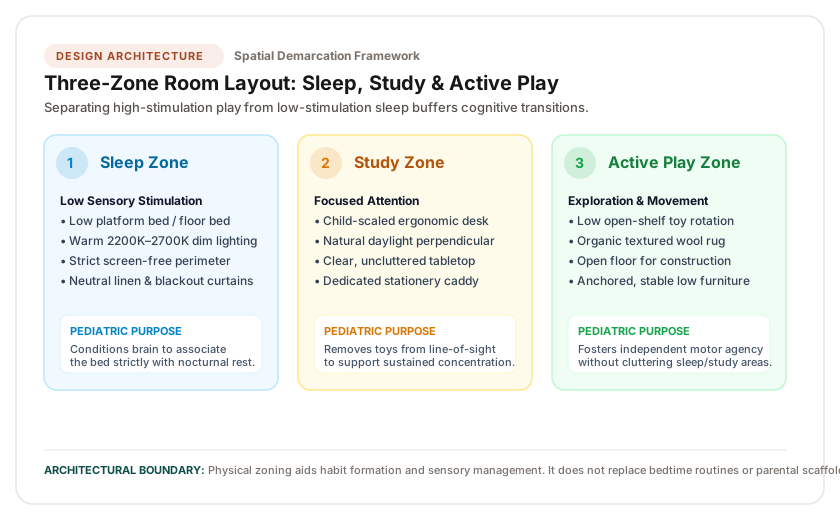
Delineating functional zones with distinct lighting and furniture orientation conditions the brain for seamless cognitive transitions between rest, study, and play.
Age-Specific Considerations
Safety Considerations for Multi-Zone Rooms
When integrating active movement and study furniture into a child's bedroom, structural safety must remain paramount:
Mandatory Structural Anchoring: All heavy furniture—including study desks, storage bookcases, and climbing wall bars—must be securely fastened into concrete or brick masonry walls using heavy-duty masonry anchors to prevent tipping hazards (conforming to ASTM F2057 or BIS standards).
Certified Fall Protection: If an active climbing apparatus is installed in the play zone, ensure a high-density, dual-density foam mat (at least 10–15 cm thick) is permanently stationed underneath to absorb impacts over hard floors.
Unobstructed Night Passages: Ensure the path between the bed and the bedroom door is entirely free of loose toys, cords, or furniture edges to prevent night-time tripping hazards.
Limitations of the Evidence
Parents should maintain realistic, grounded expectations:
Zoning Does Not Replace Emotional Connection: A beautifully zoned sleep sanctuary cannot eliminate bedtime anxiety if a child feels disconnected. Loving parental presence, conversation, and emotional warmth remain the core foundation of pediatric sleep.
Flexibility in Indian Joint Families: In multi-generational homes where grandparents or guests share rooms, strict physical boundaries may need to be adapted. The key is maintaining sensory consistency (lighting and bedtime routines) even when physical furniture arrangements are flexible.
Frequently Asked Questions
We live in a 2BHK flat and our child shares a room with us. How can we zone our space?
You do not need a separate room. In a shared master bedroom, create a dedicated "sleep cocoon" for your child using a corner setup, warm bedside lighting, and a distinct floor rug. Keep their study and active play zones in the living area. What matters most is that the child's sleeping surface remains free from toys and daytime clutter.
Is it harmful to read a storybook in bed? Doesn't that violate stimulus control?
Not at all. Stimulus control warns against high-arousal, stimulating activities (screen gaming, roughhousing, academic testing). Quiet, parent-child shared reading in bed with dim warm lighting is a proven, evidence-based co-regulation ritual that lowers cortisol and supports sleep onset.
My child refuses to sit at their study desk and prefers doing homework at the dining table. What should I do?
In young children, social proximity often trumps spatial design. A six-year-old may do homework at the dining table simply to be near a parent working in the kitchen. If this occurs, apply zoning principles to the dining area: clear away condiments and clutter, turn off the living room television, provide a footstool so their feet are grounded, and restore the table to a clean surface once homework concludes.
Related Kubeplay Parents Corner Articles
Can a Well-Designed Playroom Reduce Your Child's Screen Time? What Research Says
Why Movement Matters: How Climbing, Balancing and Crawling Support Early Development
Can a Dedicated Study Space Help Children Concentrate?
Purposeful Spaces Crafted for Families
At Kubeplay, we believe children's spaces should be safe by design, prioritize movement before screens, and be crafted to make family life genuinely enjoyable. While no room layout can replace consistent parenting and loving routines, our concept rooms are architecturally engineered around separate sleep, study, and play zones—helping families create an orderly, supportive home where children can rest, learn, and grow. Explore our purposeful children's spaces at kubeplay.com.
When space speaks clearly, children listen effortlessly. Zoning is not about having more square footage; it is about giving each brain state its rightful, undisturbed home.
A Kubeplay connection
Spaces that nurture independent growth
At Kubeplay, we design children’s rooms that respect how children naturally move, play, rest and learn. Every piece of furniture, zoned boundary and accessible shelf is built with natural wood, non-toxic finishes and child-centred ergonomics.
Explore Kubeplay child space designs