


Key Takeaways for Busy Parents
Fast-Paced Screens Acutely Tax Executive Function: Controlled laboratory experiments show that just 9 minutes of viewing fast-paced cartoons causes an immediate, measurable impairment in young children's executive function and impulse control compared to drawing or watching slow-paced shows.
Not All Media Has the Same Impact: Research demonstrates that slow-paced, realistic educational programming does not cause the acute executive function depletion triggered by fast-paced, fantastical cartoons. Pacing and content matter.
Electronic Toys Suppress Parent-Child Communication: In a controlled trial published in JAMA Pediatrics, battery-powered "educational" toys that light up and talk resulted in significantly fewer adult words, fewer conversational turns, and fewer child vocalizations compared to traditional wooden blocks and books.
The 90/10 Educational Rule of Thumb: Respected child psychologist Jane Healy proposed that the most engaging developmental toys are "90% child and 10% toy"—simple, open-ended materials that leave the imaginative storytelling and problem-solving to the child rather than relying on pre-programmed computer chips.
Invitations to Play Lower Friction: Drawing from the Reggio Emilia concept of the physical environment as a "third teacher," displaying curated, open-ended materials on low, reachable shelves lowers the behavioral activation energy required for a child to initiate self-directed physical play.
What the Scientific Research Actually Says
To understand why real-world play struggles against digital screens, we must examine the cognitive contrast between rapid digital media and physical materials:
1. The 9-Minute Cartoon Trial: How Screen Pacing Affects Working Memory
In a landmark randomized controlled experiment published in Pediatrics, Dr. Angeline Lillard and Jennifer Peterson investigated the acute cognitive impact of different play media on four-year-old children.
Sixty four-year-olds were randomly assigned to one of three nine-minute conditions:
Watching a fast-paced, fantastical cartoon featuring rapid scene transitions (camera cuts occurring every 3 to 4 seconds).
Watching a slow-paced, realistic educational cartoon.
Drawing quietly with markers and paper.
Immediately afterward, all children were tested on four standardized tasks measuring executive function: Delay of Gratification (waiting for a desired snack), the Tower of Hanoi (planning steps), the Head-Toes-Knees-Shoulders task (inhibitory control), and a Backward Digit Span (working memory).
The results were striking: children who watched just nine minutes of the fast-paced cartoon performed significantly worse across the executive function tests ($p < 0.05$). In contrast, children who watched the slow-paced show performed just as well as the children who drew with markers.
Important Scientific Correction: Popular parenting blogs often claim that this experiment proved "cartoons fry dopamine receptors." This is factually false. Lillard and Peterson measured behavioral task performance; they did not measure dopamine, blood markers, or neurotransmitters.
What the behavioral evidence actually demonstrates is that rapid visual scene cuts and fantastical events place heavy demands on immature prefrontal working memory, leaving the child temporarily depleted in self-regulation and impulse control. Handing a child a wooden puzzle immediately after a fast-paced show is futile: compared to the rapid visual refresh of the screen, physical objects demand active, self-directed mental effort that the child is temporarily too depleted to provide.
2. The Electronic Toy Trap: Why Battery Toys Backfire
In recent years, the toy market has exploded with "smart" battery-operated toys—musical trucks that recite numbers, singing alphabet caterpillars, and plastic robots that flash when pressed. Parents buy them assuming they give children an educational head-start.
In an exhaustive study published in JAMA Pediatrics, Dr. Anna Sosa of Northern Arizona University evaluated parent-infant communication during play across three toy categories: electronic toys, traditional open-ended toys (wooden blocks and shape sorters), and board books.
The findings challenged conventional toy marketing:
Electronic toys were associated with significantly fewer adult words spoken ($p < 0.001$), fewer conversational turns, fewer parental content-specific words, and substantially fewer infant vocalizations compared to traditional toys and books.
When a toy talks, sings, and flashes on its own, it commands the center of attention. The parent tends to sit back passively, allowing the electronic chip to "entertain" the child, and the child simply pushes buttons to trigger pre-programmed sounds.
With traditional wooden blocks or picture books, however, the toy is completely inert. It does nothing on its own. The parent and child must create the narrative together: "Look, the tall red tower is falling! Should we build a bridge for the cow?" Traditional play sparks rich linguistic scaffolding; electronic toys displace it.
3. The 90/10 Rule: Open-Ended Construction vs. Closed Entertainment
In her seminal work on early child development, educational psychologist Dr. Jane Healy formulated what is now widely recognized across early childhood pedagogy as the 90/10 Rule of Thumb :
A High-Value Developmental Toy: 90% child and 10% toy. The object is simple, flexible, and open-ended (wooden unit blocks, playdough, cardboard boxes, magnetic tiles). The child provides 90% of the imagination, physical manipulation, and narrative problem-solving.
An Entertainment Gadget: 90% toy and 10% child. The gadget sings, flashes, dances, or drives. The child merely acts as an audience member pushing a plastic button.
When a toy does 90% of the work, a child's brain quickly disengages. Once they have pushed the button five times and heard the song, novelty evaporates and boredom strikes. This is why toy chests filled with single-purpose electronic gadgets are consistently abandoned in favor of screens.
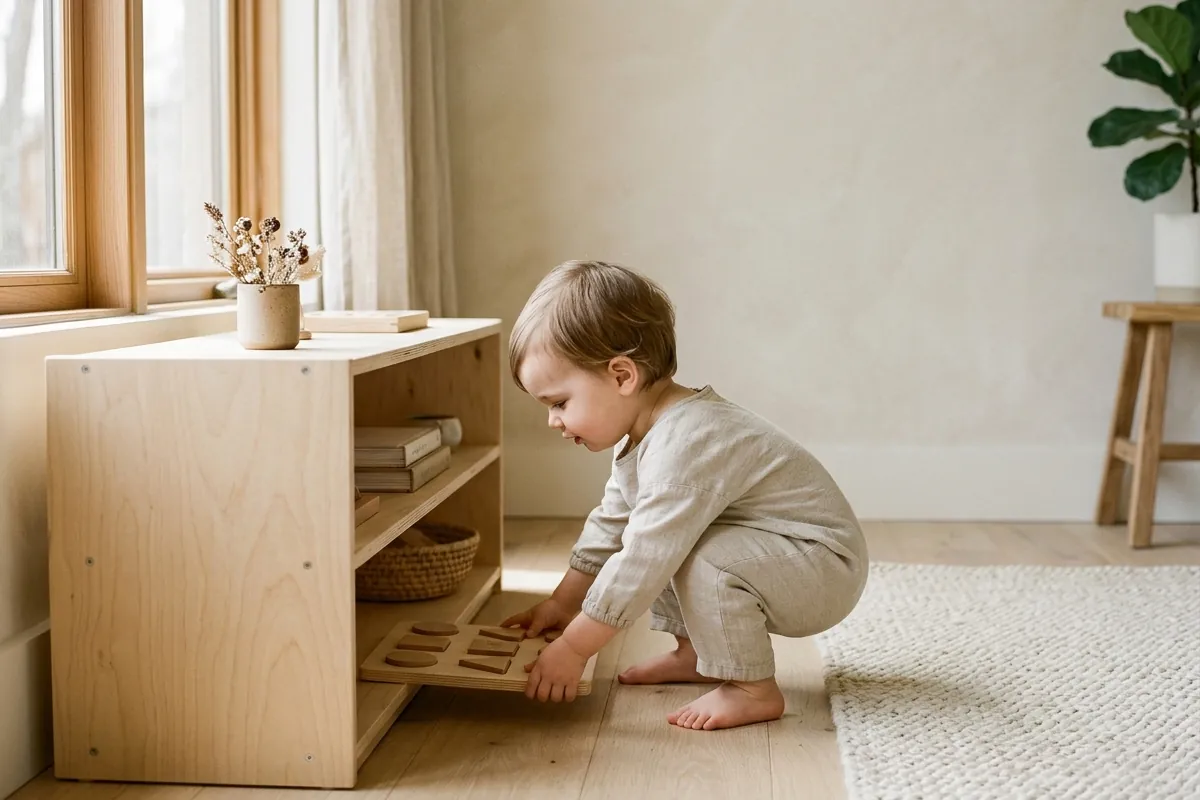
The Developmental Mechanisms: The 3D Multisensory Advantage
Why does hands-on physical play support early neurodevelopment in ways that screens cannot? Because early learning is an embodied, sensorimotor process:
1. The Sensorimotor Reality
On a touchscreen tablet, every virtual object feels identical: flat, smooth glass. A virtual block has no physical weight, no gravitational balance threshold, no tactile grain, and no spatial friction.
In the physical world, when a toddler stacks a wooden block, their nervous system receives tactile, visual, proprioceptive (muscle pressure), and auditory feedback simultaneously. This multisensory integration builds the spatial and mathematical mental maps that underpin future cognitive reasoning.
2. Active Agency vs. Passive Consumption
When a child completes a pre-programmed video game level, they are executing an algorithm coded by a software engineer.
When a child builds an imaginary fort out of wooden rungs, sofa cushions, and cotton bedsheets, they are the sole architect, engineer, and storyteller. This deep agency builds intrinsic motivation—the internal satisfaction of saying: "I conceived this, I built this with my own hands, and it exists because of me".
The Early Childhood Video Deficit Effect
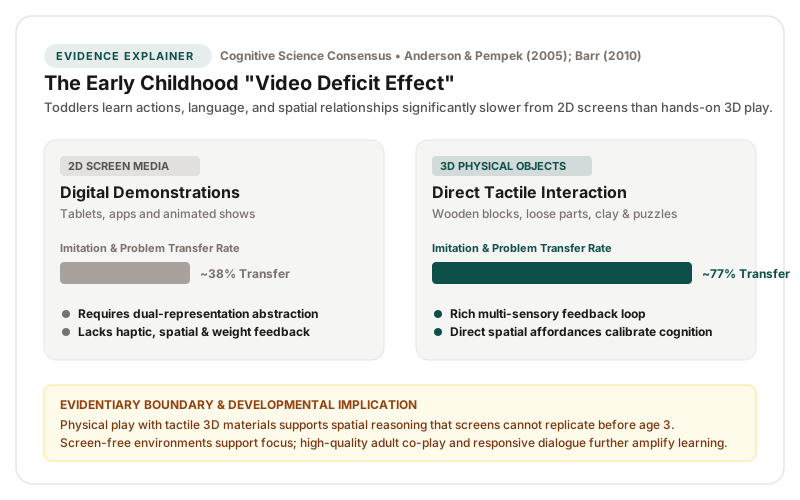
Anderson & Pempek (2005); Barr (2010): Toddlers transfer problem-solving actions from 3D objects with twice the fidelity of 2D screen demonstrations.
What the Findings Mean for Children
Restoration of Attentive Stamina: Stepping back from fast-paced visual media allows a child's working memory to function without acute sensory depletion. They regain the capacity to engage with puzzles, drawing pads, or construction sets for 20 to 45 minutes of focused play.
Reduced Post-Screen Irritability: The emotional meltdowns that frequently occur when a phone or television is switched off reflect acute cognitive fatigue and sudden sensory transitions. Real-world play transitions smoothly without behavioral whiplash.
Fine and Gross Motor Competence: Physical play exercises the palmar grasps, pincer grips, bilateral coordination, and core balance required for writing, sports, and spatial navigation.
What the Findings Mean for Parents
Freedom from Constant Digital Bargaining: When recreational screens are removed from the daily play environment, parents no longer endure the exhausting daily negotiations of "just five more minutes, please!"
Richer Relational Conversations: When toys are inert and open-ended, spontaneous language exchanges and cooperative problem-solving naturally increase between parents, grandparents, and children.
Financial and Space Efficiency: Parents can stop wasting money on cheap plastic battery gadgets that break or lose novelty within 48 hours. A curated set of quality open-ended materials serves children across multiple developmental years.
Practical Environmental Strategies to Make Real Play Appealing
To make real-world physical play compelling, parents must apply environmental choice architecture: raise the friction for screens, and lower the friction for physical play.
1. Set Up Reggio Emilia "Invitations to Play"
In the famed Reggio Emilia educational philosophy, the physical environment is honored as the child's "third teacher".
Children rarely initiate play when toys are dumped into an opaque plastic tub with a tight lid.
Instead, set out provocations on low, child-accessible shelves or small tables:
Lay out a wooden tray with a lump of natural modelling clay and three wooden rollers.
Set up four wooden building blocks with two toy trucks positioned right next to them on the rug.
Place a piece of textured paper on an easel with three accessible oil pastels.
When a child walks into the room, their eyes land on an open, intriguing invitation that sparks immediate, self-directed exploration.
2. Create High Physical Friction for Screens
Make accessing digital devices deliberately difficult:
Never leave tablets charging on living room coffee tables or kitchen counters at child eye level.
Keep all portable screens stored in an overhead cabinet or parent's workspace.
When a child asks for a device, the answer is physical and environmental: "Our screens live in the study, and today the screens are resting."
3. Anchor the Space with an Indoor Movement Zone
Children often seek screens when their physical bodies are under-stimulated. In Indian cities where outdoor park visits are restricted by weather or traffic, gross-motor play must have an indoor home.
Install a wooden climbing ladder (Swedish wall bars) mounted to a masonry wall.
Station a curved balance board or soft tumbling mat in the center of the play area.
When a child can climb, balance, and tumble safely indoors, physical movement provides the rich proprioceptive release that screens can never replicate.
4. Manage the Transitional Adjustment Period
When you reduce daily recreational screen time, expect some initial resistance.
For the first 3 to 7 days, children accustomed to fast-paced digital media may experience temporary restlessness, irritability, or complain of intense boredom.
Do not panic, and do not back down. This boredom is the fertile soil from which self-directed creative play emerges.
Offer sensory co-regulation: spend 10 minutes sitting on the rug initiating a puzzle, playing with water in the sink, or navigating an indoor obstacle course together. Once the child adapts to the unhurried rhythm of the physical world, their autonomous curiosity will naturally take over.
The Friction-Reversal Living Environment
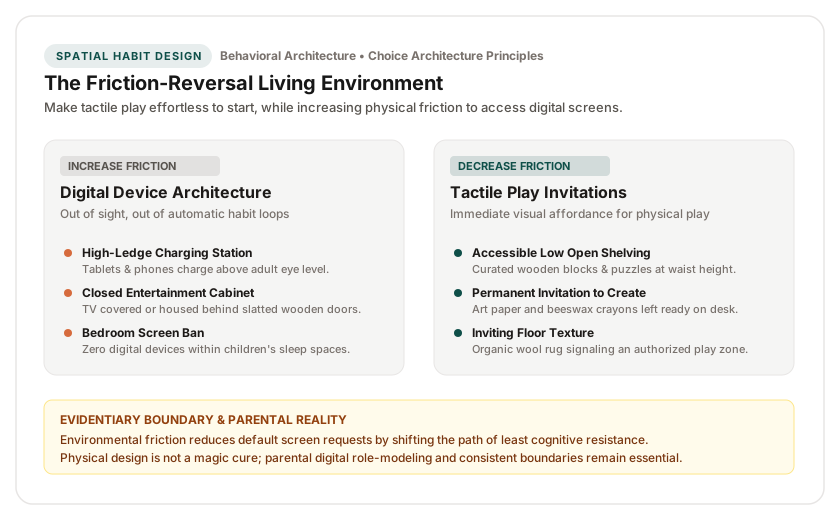
Choice Architecture: Designing the environment to make tactile play effortless to start while keeping digital screens tucked away.
Age-Specific Real-World Play Toolkit
Safety Considerations for Screen-Free Play Zones
Non-Toxic Natural Materials: Ensure wooden toys and climbing structures are treated with child-safe, saliva-resistant, zero-VOC natural oils or water-based lacquers.
Choke-Tube Screening: Any loose parts in open-ended baskets for children under three must exceed the international 3.17 cm (1.25 inch) choke-tube diameter standard.
Anchored Furniture: Low open shelving units and storage bookcases must be anchored into masonry walls to eliminate tipping hazards during active play.
Limitations of the Scientific Evidence
Not All Media is Harmful: Slow-paced, educational programming (such as gentle nature documentaries) or live interactive video calls with grandparents in other cities do not produce the acute executive function depletion of fast-paced cartoons. Content, pacing, and co-viewing context matter significantly.
Patience is Required: An environmental change will not transform a child overnight. The behavioral habit transition requires consistency, emotional warmth, and parental modeling over several weeks.
Frequently Asked Questions
What should I do during the first three days when my child throws tantrums without the tablet?
Treat the tantrum as a predictable behavioral adjustment, not defiance. Stay calm and close: "I know it feels hard right now. The tablet is resting today, but I am right here with you." Offer heavy physical sensory work: invite them to knead bread dough, jump on the crash mat, or play with measuring cups in a basin of water. The tactile and physical input helps calm the nervous system without resorting to digital pacifiers.
Are educational apps on tablets really bad if they teach the alphabet or numbers?
While educational apps can teach rote memorization, they displace sensorimotor translation. A preschooler tapping a 2D letter 'B' on glass does not develop the fine-motor dexterity, hand-eye coordination, or spatial orientation gained by manipulating physical wooden letters, tracing shapes in sand, or building letters with wooden blocks.
Real wooden and open-ended toys seem much more expensive than plastic battery toys. Is it worth it?
In the long run, open-ended toys are vastly more economical. A plastic singing battery toy is usually outgrown in three months. A high-quality set of wooden building blocks or magnetic tiles will be used at age two for simple stacking, at age four for building animal barns, and at age seven for complex architectural bridges. You buy them once, and they serve an entire childhood.
Related Kubeplay Parents Corner Articles
Bringing Childhood Back to the Real World
At Kubeplay, our design philosophy is built on three pillars: Safe by design, movement before screens, crafted for families. We design children's spaces that make real-world, three-dimensional physical play irresistible—featuring child-accessible shelving, natural open-ended play stations, and safe indoor movement equipment that captivate your child's natural curiosity. Discover purposeful children's spaces at kubeplay.com.
We cannot simply tell a child to get off screens; we must give them a physical world that is tactile, accessible, and thrilling enough to run toward.
Related to this topic
Designing a space for play, movement and learning?
Kubeplay's interior-design services cover children's bedrooms, playrooms and study spaces.
Explore Kubeplay children's-space servicesFurniture ideas for the room
Explore category guidance and bespoke design options. Individual product availability is confirmed separately.