


Key Takeaways for Busy Parents
Unstructured Time Correlates with Self-Directed Focus: Observational studies in developmental psychology demonstrate that children who spend more time in less-structured, self-directed activities exhibit stronger self-directed executive function (p < 0.05). While correlational, research suggests that self-governed play allows children to practice formulating goals and managing attention without external prompts.
Solitary Play is Normative, Not Lonely: Decades of observational research confirm that constructive solitary play (quietly building with blocks, sketching, exploring puzzles alone) is a healthy developmental milestone that reflects deep object engagement, not social maladjustment or withdrawal.
Parental Downtime Protects Family Well-Being: Research on parental burnout demonstrates that continuous, unbuffered caregiving demands without cognitive recovery severely deplete emotional patience. Supporting a child's capacity to play independently is a vital health buffer that protects parental warmth.
Four Crucial Concepts Must Be Distinguished: Developmental scientists distinguish between independent play (child-directed), unstructured play (open-ended), solitary play (playing without peers), and unsupervised play (play without adult oversight). Young children require supervised autonomy, not total abandonment.
Realistic Duration Expectations: Independent play develops incrementally: typically 10–15 minutes for toddlers, 20–30 minutes for preschoolers, and 45–60 minutes for early primary school children.
What the Scientific Research Actually Says
To understand the developmental dynamics of independent play, we must examine how children acquire self-regulation and how modern caregiving pressures impact family mental health.
1. The Executive Function Evidence: Correlation vs. Causation
In an influential developmental study published in Frontiers in Psychology, researchers at the University of Colorado tracked the daily time use of 70 six-year-old children across a full week. Parents recorded how many hours children spent in adult-structured activities (formal lessons, organized sports, adult-directed chores) versus less-structured time (free play, drawing, spontaneous reading, and unhurried family exploration).
The children were subsequently evaluated on standardized tasks measuring self-directed executive functioning—specifically their ability to generate ideas, plan sequences, and shift mental sets without adult guidance.
The findings showed a clear statistical pattern:
Children who spent more time in less-structured activities exhibited significantly better self-directed executive functioning on a verbal fluency task (r = 0.28, p = 0.02; hierarchical regression \beta = 0.28, t = 2.34, p = 0.02, controlling for age, nonverbal IQ, and SES).
Conversely, children who spent more time in adult-structured activities exhibited poorer self-directed executive functioning (\beta = -0.25, t = -2.08, p = 0.04).
Critical Scientific Boundaries: The authors explicitly emphasized that these findings are correlational, not causal. This study does not prove that less-structured time independently causes higher executive function; it is entirely plausible that children with naturally higher self-regulatory abilities are granted greater freedom by parents. Furthermore, Barker et al. did not evaluate screen time reduction, intelligence/IQ growth, or parental leisure time. Independent play is an experiential practice arena, not a clinical guarantee of parental free time.
Nevertheless, neuroscientists such as Dr. Adele Diamond explain the underlying biological plausibility. Executive functions operate like cognitive muscles: when an adult constantly directs every step of play ("Now put the yellow block here; now color inside the lines"), the adult's prefrontal cortex does the executive planning. When a child initiates their own play, their own brain must formulate the goal, self-monitor progress, and navigate minor errors.
2. The Science of Solitary Play: Dispelling the Myth of Loneliness
In many cultures—and especially within close-knit Indian extended families—a child sitting quietly playing by themselves in a corner is often viewed with concern. Grandparents or well-meaning relatives might worry that the child is lonely or antisocial.
Developmental psychology has thoroughly investigated this concern. In a classic study published in Child Development, Dr. Robert Coplan and colleagues observed four-year-old children during free play to categorize different forms of solitude :
Solitary-Passive Play: Constructive, quiet engagement with objects (building with blocks, drawing, exploring puzzles, arranging figurines).
Reticent Behavior: Anxiously hovering at the periphery of other children's activities, watching without joining in, or aimless unoccupied wandering.
Coplan's findings were definitive: solitary-passive play was completely unrelated to social anxiety, peer rejection, or behavioral maladjustment. It represented a completely normal, healthy, constructive form of play where children deeply explore the physical properties of objects at their own unhurried pace.
Solitary play is not a symptom of isolation; it is a child's natural cognitive workshop.
3. Parental Burnout: Why Restorative Downtime is a Health Resource
In Clinical Psychological Science, leading researchers Moïra Mikolajczak and Isabelle Roskam introduced the Balance Between Risks and Resources (BR^2) model of parental burnout.
Parental burnout is characterized by chronic emotional exhaustion, feeling overwhelmed by caregiving, and a sense of disconnection from one's children. Their clinical data demonstrates that burnout is driven by a persistent imbalance: when daily parenting demands (relentless stimulation, constant direct supervision, hyper-scheduling) consistently outstrip parental resources (restorative personal time, emotional bandwidth, sleep).
When parents believe they must act as 24/7 animators, their own mental resources are depleted to zero. This chronic depletion leads to irritability, shortened tempers, and maternal guilt.
As the American Academy of Pediatrics points out in its clinical guidance on play, child-directed independent play is not only beneficial for child resilience—it also protects the parent-child relationship by providing parents with the essential breathing room needed to parent with patience, warmth, and presence.
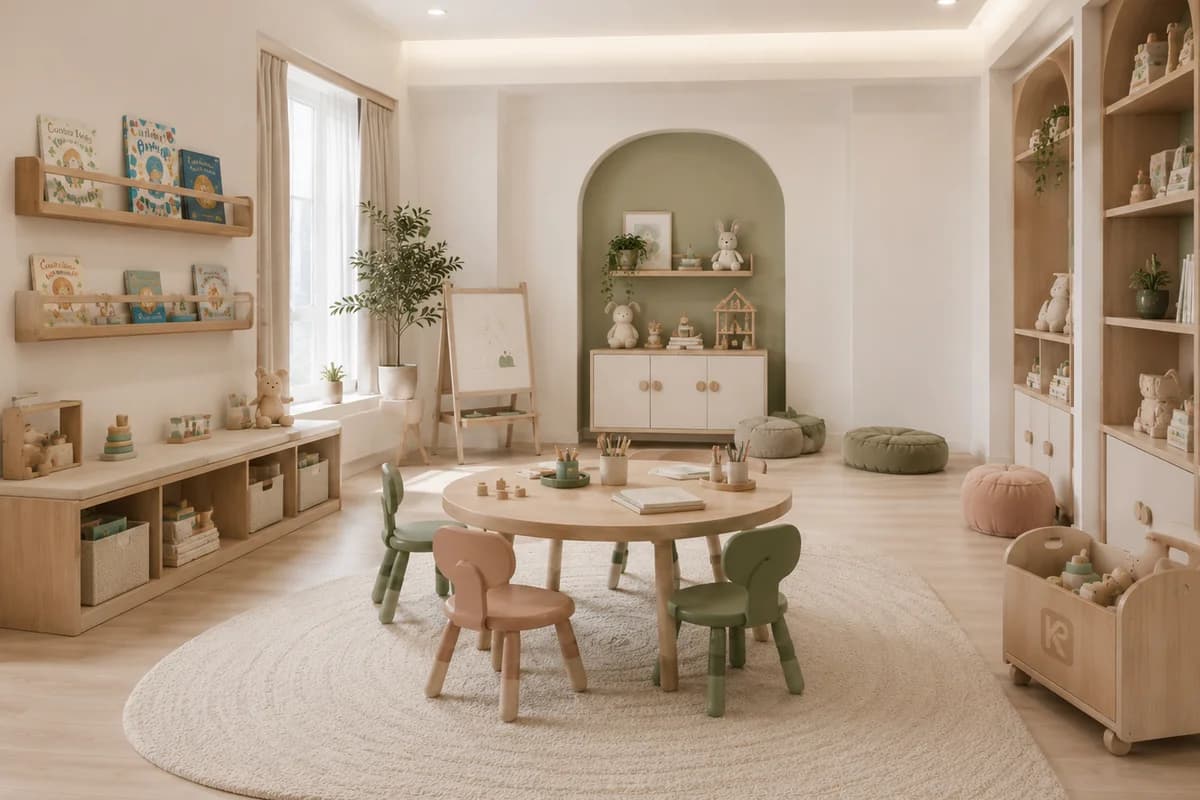
Conceptual Clarification: The Four Forms of Play
To prevent confusion, parents must understand that developmental science distinguishes between four distinct concepts:
What This Means for Your Child
When supported with an appropriate environment and realistic expectations, independent play offers children valuable developmental opportunities:
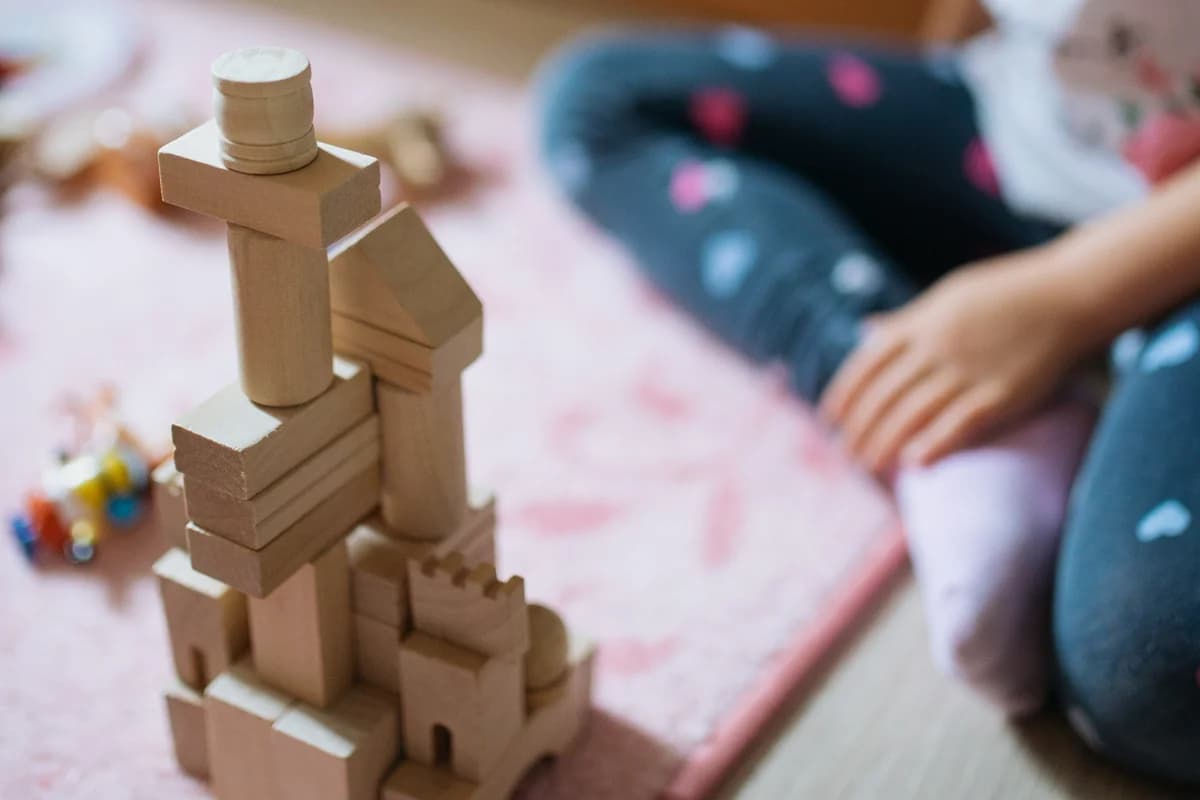
Frustration Tolerance: When a block tower falls during independent play, an adult is not there to rebuild it instantly. The child experiences a micro-moment of frustration, pauses, and decides whether to try again. This self-soothing cycle is how real-world emotional resilience is formed.
Internal Locus of Control: According to Self-Determination Theory (Ryan & Deci, 2000), children experience genuine motivation when their need for autonomy is fulfilled. Deciding what to touch, how to build, and when to stop gives children a sense of agency and self-efficacy.
Internalized Self-Talk: Vygotskian developmental psychology demonstrates that during solo play, children frequently engage in private speech—talking out loud to themselves ("First this block goes here; now wait, that's too heavy"). This self-talk is the primary mechanism through which children internalize working memory and impulse control.
What This Means for Parents
Guilt-Free Breathing Room: You can drink a cup of tea while it is hot, answer an important work email, or simply rest for 20 to 30 minutes, knowing that your child's solo play is actively exercising their cognitive autonomy.
Relief from Entertainment Pressure: You are liberated from the exhausting mandate to plan every minute of the weekend. You do not need to feel guilty when your child is temporarily unentertained.
More Meaningful Connection: When parents have had regular restorative breaks throughout the day, they are far more patient, emotionally present, and loving during intentional shared moments, such as family dinners and bedtime reading.
Practical Environmental Strategies: Designing for Supervised Autonomy
Children cannot play independently in an environment that is hazardous, chaotic, or physically inaccessible. To invite autonomous exploration, the physical space must be thoughtfully prepared:
1. The "Yes Space" Principle
In early childhood pedagogy, a "Yes Space" is a demarcated area where everything the child can touch is permitted, safe, and child-sized.
If construction toys or art materials are placed on high shelves behind closed cabinet doors, the child must interrupt you every ten minutes to ask for permission. This breaks independent momentum before it starts.
Install low, open-facing shelves where materials are visible and reachable without adult assistance.
Ensure all heavy bookcases and storage units are firmly anchored into masonry walls (conforming to ASTM F2057 or BIS standards) to eliminate tipping hazards.
2. Choose Responsive, Open-Ended Materials
Single-purpose electronic battery toys (toys that talk, sing, or dance when a button is pressed) dictate how they must be used. Once the button has been pressed, the child becomes a passive observer.
Curate open-ended materials: wooden unit blocks, magnetic tiles, playsilks, simple animal figures, modelling dough, and plain paper with crayons.
Open-ended toys have no predetermined "correct" outcome, inviting the child to formulate their own play goals.
3. Practice "Supervised Autonomy"
Independent play for young children (ages 1–5) does not mean leaving them in a room with the door shut.
Position the independent play area where you have easy visual or auditory line-of-sight from the kitchen or work desk.
In attachment theory (Bowlby, Ainsworth), a child explores confidently when they know their "secure base" is accessible. Knowing you are nearby gives their nervous system the security needed to lose themselves in play.
4. Resist the "Helpfulness Reflex"
When you see your four-year-old struggling to balance a wooden arch or placing a puzzle piece upside down, your natural parenting instinct is to jump in and fix it.
Pause and observe. Count silently to twenty.
Often, after a brief pause and two failed attempts, the child discovers the solution themselves, experiencing a genuine burst of self-efficacy. Constant adult intervention robs children of the opportunity to solve problems independently.
Play Structure & Child Executive Function
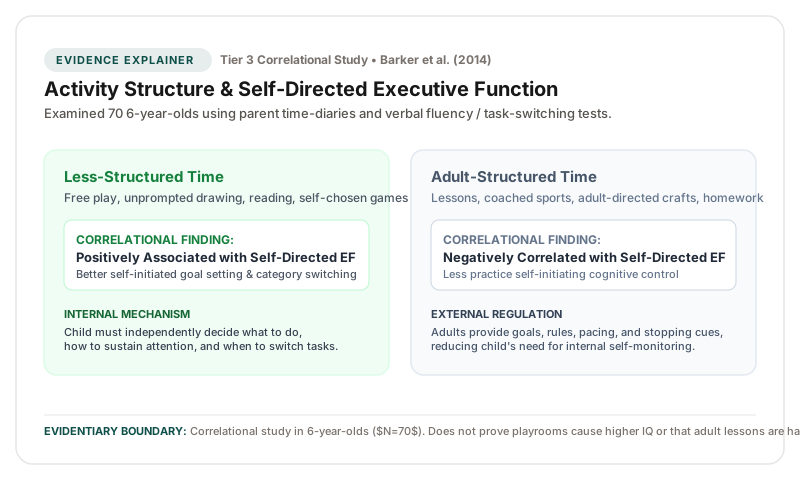
Barker et al. (2014): Children spending more time in less-structured play demonstrated superior self-directed executive function.
Realistic Age-by-Age Independent Play Benchmarks
Independent play is a developmental capacity that matures over time. Expecting a two-year-old to play alone for an hour is biologically unrealistic:
Safety Considerations for Supervised Independent Play
Continuous Passive Supervision: Toddlers and preschoolers must never be left completely unmonitored. Independent play means independent cognition, not absence of adult safety oversight.
Choke-Hazard Screening: Any loose parts accessible in play baskets for children under three years must comply with international choke-tube diameter standards (>3.17 cm).
Physical Hazard Proofing: Cover unused electrical sockets, round off sharp table corners, and ensure window blinds do not have dangling cords.
Limitations of the Scientific Evidence
Independent Play is Not a Substitute for Connection: Independent play builds autonomy, but it is complementary to loving, responsive parent-child engagement. If a child feels emotionally insecure, stressed, or unwell, they cannot play independently.
Correlations Are Not Guarantees: Providing unstructured time does not guarantee that every child will develop advanced executive functioning. Temperament, neurodiversity, and family dynamics play significant roles.
Frequently Asked Questions
My child cries and follows me everywhere, saying 'Mama, play with me!' How do I begin?
Start with the "Bridge Strategy." Sit on the play rug and engage actively with your child for 5 to 7 minutes to help them enter a play narrative (for example, laying the foundation of a block city). Once they are absorbed, say gently: "I am going to sit right here on the sofa and read while you build the bridge." Stay present and gradually increase your distance over two weeks.
In our Indian joint family, relatives think letting a child play alone is neglectful. How do I address this?
Explain the science gently. Share that developmental pediatricians consider independent, self-directed play to be essential practice for building focus, problem-solving, and school readiness. Clarify that you are supervising nearby, but allowing the child's brain to practice thinking on its own.
Does watching an educational video count as independent play?
No. While screen media keeps a child occupied, it is passive consumption, not self-directed play. On a screen, the algorithm dictates the pacing, imagery, and narrative. In real independent play, the child's own prefrontal cortex must generate the ideas, manipulate physical materials, and maintain attention.
Related Kubeplay Parents Corner Articles
Designing Spaces That Empower Independence
At Kubeplay, we believe children's spaces should be safe by design, prioritize movement before screens, and be crafted for families, not just children. Our child-accessible shelving, open-ended play layouts, and safe indoor movement equipment are intentionally engineered to empower children to explore autonomously under supervised care—giving parents the peace of mind and personal time they deserve. Discover purposeful children's spaces at kubeplay.com.
Independent play is not neglect; it is the gift of cognitive agency. When we step back, we allow our children to discover that they are capable of entertaining themselves.
Related to this topic
Designing a space for play, movement and learning?
Kubeplay's interior-design services cover children's bedrooms, playrooms and study spaces.
Explore Kubeplay children's-space services