


The Direct vs. Indirect Fallacy: What Science Actually Says About Space and IQ
The most pervasive design myth is that a room can act as a direct causal engine of cognitive endowment. Commercial marketing frequently misinterprets neuroplasticity research to claim that specific room themes, specialized lighting rigs, or branded furniture sets "boost brain cells" or accelerate IQ development.
In his landmark systematic review published in the Annual Review of Psychology, environmental psychologist Gary Evans synthesized over three decades of empirical research on children’s physical environments ``. His central finding is unambiguous: physical environments rarely act as direct causal agents of cognitive capacity; rather, they serve as mediators and moderators that either buffer or amplify chronic developmental strain ``.
Commercial Design Myth:
[Expensive / Themed Room] ──(Direct Biological Causation)──> [Higher IQ & Genius]
Empirical Environmental Science:
[Physical Environment: Calm, Organized, Acoustically Buffered]
[Lower Cognitive Load + Reduced Sensory Fatigue + Predictable Agency]
[Protected Working Memory, Deeper Play & Resilient Self-Regulation]
When a child’s physical space is characterized by chronic sensory unpredictability—such as visual clutter, loud ambient street noise, physical disorganization, and cramped, inaccessible furniture—the child’s nervous system must constantly work in overdrive ``. The brain expends precious metabolic and attentional resources simply filtering out background chaos. Evans documented that chronic environmental chaos correlates with:
Elevated baseline resting cortisol and sympathetic autonomic arousal ``.
Reduced task persistence and earlier onset of frustration when solving cognitive puzzles ``.
Impaired reading comprehension and language acquisition delays ``.
A thoughtfully arranged room does not make a child "gifted." Its true scientific value lies in cognitive load reduction ``. By removing background friction, visual distractions, and auditory pollution, a well-designed space creates a protective sanctuary where a child’s natural cognitive capacities can flourish unimpeded.
The Wall Paradox: Why "Educational" Posters May Be Draining Your Child's Focus
Driven by the well-intentioned desire to stimulate early learning, many parents transform their child's bedroom or study nook into a miniature classroom. Walls are papered with vibrant alphabet charts, phonetic guides, numbers, animal taxonomies, and multi-coloured decorative decals.
Yet, controlled experimental research demonstrates that this visual saturation can actively sabotage early learning.
In a landmark laboratory study published in Psychological Science, Anna Fisher, Karrie Godwin, and Howard Seltman investigated how visual classroom environments influence attention allocation and learning in kindergarten children ``. The researchers placed children in two distinct conditions:
A heavily decorated condition, where walls were densely covered with educational posters, charts, and colorful banners.
A sparse, visually calm condition, where wall displays were stripped back and kept clean.
The findings were striking:
In the heavily decorated environment, children spent 28.4% of their time off-task and distracted by ambient wall decor, compared to just 15.6% of their time in the sparse environment (p < 0.001) ``.
Most crucially, this attentional diversion directly undermined academic performance: children demonstrated significantly lower learning comprehension scores in the decorated condition (an average of 42% accuracy) compared to the sparse condition (55% accuracy, p < 0.001) ``.
================================================================================
FISHER ET AL. (2014) CONTROLLED EXPERIMENT ON VISUAL ENVIRONMENT (N = 24)
================================================================================
Metric Sparse Environment Heavily Decorated
Off-Task Distraction Time: 15.6% 28.4% (p < 0.001)
Learning Comprehension Score: 55.0% 42.0% (p < 0.001)
================================================================================
The Developmental Mechanism: Exogenous Attentional Capture
Why are young children so vulnerable to wall decor? The human brain possesses two primary mechanisms for directing attention:
Endogenous (Goal-Directed) Attention: Controlled by the prefrontal cortex, this allows an individual to consciously sustain focus on a chosen task (e.g., reading a book or drawing).
Exogenous (Stimulus-Driven) Attention: An automatic, involuntary evolutionary reflex that directs the eyes toward bright, moving, or high-contrast peripheral stimuli ``.
In young children (ages 2 to 8), the prefrontal neural networks responsible for top-down endogenous attention are still actively developing ``. Children lack the adult inhibitory capacity to suppress peripheral visual noise. Every high-contrast poster, glittering sticker, or brightly patterned wallpaper strip involuntarily pulls their gaze away from their workbook or toy ``.
> The Design Implication: Your child's study desk and primary sleep perimeter should face a calm, neutral horizon. Visual displays should not be plastered indiscriminately across all four walls. Instead, designate a single, dedicated, eye-level "gallery zone" elsewhere in the room where artwork can be rotated mindfully ``.
Visual Clutter vs. Working Memory Allocation
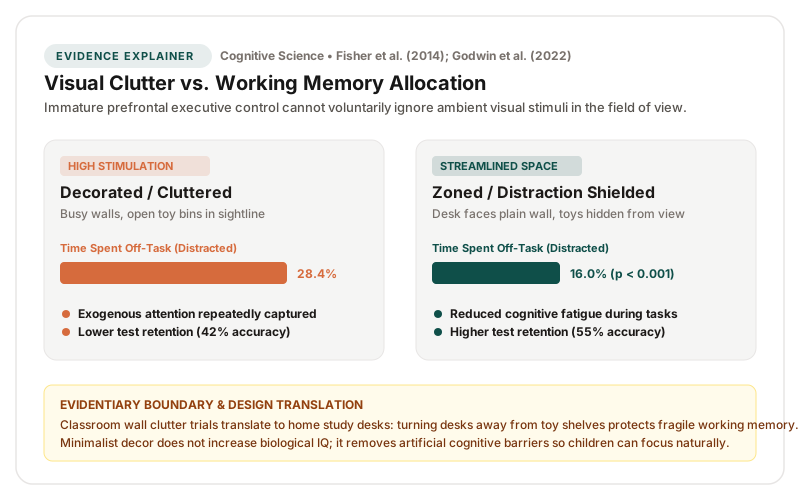
Fisher et al. (2014); Godwin et al. (2022): Kindergarteners spent nearly double the time off-task in heavily decorated rooms compared to streamlined environments.
The Hidden Cognitive Tax: Urban Noise and Auditory Working Memory
In modern Indian metro apartments—whether in Mumbai, Bengaluru, Delhi NCR, or Hyderabad—children are exposed to near-continuous ambient noise: vehicular horns, construction clatter, barking street dogs, high-volume television from the adjacent living room, and the hum of diesel backup generators.
While parents often assume children simply "get used to the noise," clinical and epidemiological research tells a very different story.
The cross-national RANCH study (Road Traffic and Aircraft Noise and Children’s Cognition and Health), published in The Lancet, examined 2,844 children across 89 schools to determine the cognitive impact of chronic ambient environmental noise ``. The researchers discovered a statistically significant, linear dose-response impairment in children’s reading comprehension and recognition memory (p = 0.003), even after rigorously controlling for socioeconomic status, parental education, and aircraft insulation ``. A mere 5-decibel increase in chronic ambient noise corresponded to a measurable two-month reading delay in children ``.
Continuous Urban Noise (Horns, Sirens, Household TV, Echoing Corridors)
[Auditory Masking & Chronic Perceptual Filtering]
[Immature Working Memory Depleted by Noise Suppression]
[Phonemic Discrimination Errors & Early Reading Delays]
Why Noise Blunts Developing Minds
To comprehend language or read a sentence, a young child must distinguish subtle differences between phonemes (such as "b" and "p", or "d" and "t"). When ambient background noise exceeds 45 to 50 decibels, acoustic masking occurs ``. The child’s brain must expend immense working-memory capacity merely to parse incoming speech sounds through the background din ``. Over months and years, this constant perceptual strain results in generalized auditory gating fatigue, impaired speech processing, and learned inattention ``.
Acoustic Environmental Buffering for Indian Flats
Parents cannot silence the city outside, but they can acoustically buffer the child's personal sanctuary:
Soft Textures Over Hard Echoes: Indian apartments predominantly feature hard marble, granite, or vitrified tile flooring, paired with plastered masonry walls. These dense surfaces act as acoustic echo chambers. Introducing dense, non-toxic cotton or wool rugs, fabric-lined curtains, and soft wall tapestries drastically dampens reverberation.
Door and Window Seals: Simple acoustic weather-stripping or dense rubber gaskets around bedroom doors and balcony windows can reduce incoming street noise by 6 to 10 decibels—a reduction scientifically proven to protect cognitive processing ``.
The 45 dB Standard: The American Academy of Pediatrics environmental health guidelines recommend maintaining continuous ambient background noise in children’s primary learning and sleeping quarters below 45 decibels ``.
Spatial Affordances: Designing for Agency Rather Than "Genius"
If high-end designer furniture does not raise IQ, what role does furniture play in cognitive development? The answer lies in the ecological concept of affordances, first formulated by perceptual psychologist J.J. Gibson and expanded in developmental contexts by Marketta Kyttä ``.
Children do not perceive a room in terms of square footage, resale value, or interior design aesthetics. They perceive space in terms of affordances—functional invitations for action: "Can I reach this? Can I climb that? Can I pull this out myself, or must I beg an adult?" ``.
================================================================================
PHYSICAL AFFORDANCE DESIGN: ACCESSIBILITY VS. DEPENDENCE
================================================================================
Design Dimension High-Dependence Room Affordance-Rich Room
Storage Height: High cupboards & overhead bins Low, stable open shelving (0–90cm)
Book Presentation: Spines concealed in dark boxes Forward-facing picture ledges
Toy Quantity: Deep bins with 20+ mixed items 4–6 open trays with single activities
Wardrobe Access: Heavy adult-height latches Child-height accessible coat pegs
Autonomous Agency: Child is passive / dependent Child initiates, explores, cleans up
================================================================================
In a comprehensive empirical investigation of children’s physical environments published in the Journal of Environmental Psychology, Lorraine Maxwell demonstrated that physical spatial predictability, clear territorial boundaries, and child-accessible storage significantly correlate with children’s demonstrated self-regulatory competence, task completion, and autonomous engagement (r = 0.38, p < 0.01) ``.
When furniture is designed exclusively at an adult scale:
Children must constantly ask adults for permission, assistance, and retrieval.
This dynamic cultivates subtle behavioral dependency and learned helplessness ``.
Spontaneous cognitive curiosity is repeatedly interrupted by the friction of physical barriers ``.
Conversely, when furniture is scaled to the child’s physical body:
Low, Open Shelving (0 to 90 cm) enables the child to independently select, utilize, and return materials ``.
Forward-Facing Book Ledges allow pre-literate children to select literature based on visual cover art, increasing self-directed reading initiation ``.
Child-Scale Worktables ensure feet rest flat on the floor with elbows bent at 90 degrees, eliminating postural instability that otherwise drains working memory during fine-motor tasks ``.
The Toy Density Paradox
This principle extends directly to toy storage. In a rigorous controlled trial published in Infant Behavior and Development, Carly Dauch and colleagues tested toddlers in two distinct conditions: a 4-toy environment versus a 16-toy environment ``.
The results were unequivocal: when presented with only 4 toys, toddlers engaged in significantly longer durations of uninterrupted play (p < 0.001) and demonstrated far higher-order, complex, and creative play behaviors than when surrounded by 16 toys ``. Toy saturation produces attentional superficiality; curated accessibility fosters cognitive depth ``.
The Irreplaceable Engine: Why Human Connection Always Trumps Design
In the era of "smart nurseries" and connected nursery gadgets, it is tempting to believe that high-tech interior architecture can independently stimulate cognitive growth.
Developmental science offers a resounding corrective.
In a comprehensive review published in Cognitive Development, Kathy Hirsh-Pasek and her colleagues synthesized decades of research on early language acquisition and cognitive architecture ``. Their conclusion is foundational: young children develop language, symbolic reasoning, and executive self-regulation primarily through responsive, contingent "conversational duets" with caring human adults ``.
No piece of furniture, interactive wall panel, or sensory projection system can substitute for serve-and-return communication—the reciprocal back-and-forth rhythm where a child points or babbles, and a parent warmly acknowledges, labels, and expands upon the child's focus ``.
The True Role of the Physical Room:
[Calm, Safe, Acoustically Buffered Physical Space]
[Relaxed, Unhurried Parent-Child Interaction & "Conversational Duets"]
[Robust Neural Connectivity, Language Mastery & Emotional Security]
The true purpose of children’s interior architecture is not to replace the parent, but to scaffold the parent-child relationship ``. When a room is chaotic, unsafe, or cluttered:
Parents spend their energy policing hazards, shouting "Don't touch that!", and cleaning endless floor messes ``.
The home becomes a theatre of friction and parental exhaustion.
Opportunities for shared reading, playful storytelling, and warm connection are eclipsed by survival mode ``.
When a room is safe by design, child-accessible, and visually serene:
The parent gains peace of mind and personal time while the child plays safely ``.
Household friction plummets.
When parent and child do sit together, the environment supports calm, sustained, unhurried connection ``.
The Evidence-Led Room Blueprint: 5 Scientific Principles for Indian Homes
Transforming your child’s space does not require an extravagant budget or architectural demolition. Applying five evidence-based principles can dramatically reduce cognitive load and enhance your family's daily life:
================================================================================
EVIDENCE-BASED 5-STEP COGNITIVE ROOM CALIBRATION
================================================================================
The Neutral Horizon Keep the study desk and bed walls visually calm.
Reserve posters for a dedicated, single gallery zone.
Acoustic Softening Dampen urban decibels below 45 dB using dense rugs,
blackout curtains, and door weather-strips.
Child-Scale Affordances Install low open shelving (0–90 cm) so the child
can access and return materials autonomously.
The Rule of 4 to 6 Display only 4 to 6 high-quality, open-ended items at
a time; store the rest away for weekly rotation.
Rigorous Safety Baseline Anchor all tall furniture to masonry walls (ASTM F2057);
mandate zero-VOC non-toxic finishes (<50 ug/m3).
================================================================================
1. The Neutral Horizon (Visual Field Calibration)
Inspect your child’s room from their physical eye level while sitting at their study desk or on their bed. The wall directly facing their study desk should be painted in a soft, non-reflective neutral tone (warm off-white, muted beige, or gentle earthy grey). Strip away commercial posters, sticker clusters, and bright alphabet charts from this focal plane ``. If you wish to display family photographs or your child’s artwork, frame them within a single, dedicated, organized board positioned away from their primary study line of sight ``.
2. Acoustic Softening in Concrete Apartments
To combat the echo-chamber acoustics of Indian masonry walls and marble floors, introduce sound-absorbing soft materials:
Place a thick, non-slip cotton or natural wool rug beneath the primary play and study zone.
Install lined, double-weave curtains extending from ceiling to floor over exterior balcony windows.
Ensure ambient sleep and study noise remains below the AAP guideline of 45 dB ``.
3. Child-Scale Affordances (Low, Open Shelving)
Replace tall, monolithic cupboards and opaque plastic toy trunks with low, open shelving units (no higher than 75 to 90 cm) ``. Use shallow wooden trays or open fabric baskets where each activity has a clear, visible home. When an 18-month-old or 4-year-old can see and independently select a puzzle without climbing dangerously or begging an adult, their self-regulatory confidence and executive planning circuits are activated ``.
4. Toy Rotation: The Rule of 4 to 6
Heed the experimental findings of Dauch et al. ``. Select 4 to 6 open-ended materials for the week (e.g., wooden unit blocks, a set of animal figurines, a balance board, paper with beeswax crayons, and two books). Pack the remaining toys into closed storage cupboards out of sight. Every Sunday evening, rotate two or three items. This simple intervention instantly halts the cycle of toy dumping, restores sustained play duration, and eliminates chaotic clutter ``.
5. Non-Negotiable Structural & Chemical Safety
A room can only support healthy cognitive development if it protects physical biology:
Mandatory Wall-Anchoring (ASTM F2057 Standards): In Indian homes, solid brick or concrete masonry walls provide exceptional anchoring stability. Every bookshelf, chest of drawers, and modular storage unit taller than 60 cm must be bolted directly into the masonry using heavy-duty steel brackets and expansion rawlplugs. Never rely on double-sided adhesive tape or plastic drywall toggles.
Certified Low-VOC Finishes: Volatile Organic Compounds (VOCs) off-gassing from cheap solvent-based laminates, synthetic varnishes, and particleboard glues cause chronic respiratory irritation and headaches, undermining cognitive focus. Mandate certified zero-VOC, water-based non-toxic finishes compliant with international pediatric environmental standards (<50 \mu g/m^3) ``.
Summary Matrix: Design Hype vs. Developmental Science
Conclusion: Designing a Sanctuary, Not a Showroom
As parents, it is profoundly liberating to realize that you do not need an extravagant, picture-perfect designer showroom to support your child’s cognitive potential. The brain does not thrive on luxury laminates, trendy color swatches, or walls plastered in flashcards.
The developing brain thrives on predictability, calm, safety, and agency ``.
When you strip away visual noise from your child's study desk, you protect their fragile working memory from exhaustion ``. When you buffer the sound of street traffic with a plush rug, you preserve their auditory processing for language and reading ``. When you place toys and books on low, accessible shelves, you send a quiet, powerful message that they are capable of initiating their own learning and tidying their own world ``. And when you create a space that is genuinely safe by design, you give yourself the greatest parental gift of all: the peace of mind to step back, exhale, and watch your child flourish with confidence.
References
Fisher, A. V., Godwin, K. E., & Seltman, H. (2014). Visual environment, attention allocation, and learning in young children: When too much of a good thing may be bad. Psychological Science, 25(7), 1362–1370. DOI: 10.1177/0956797614533801
Evans, G. W. (2006). Child development and the physical environment. Annual Review of Psychology, 57, 423–451. DOI: 10.1146/annurev.psych.57.102904.190057
Maxwell, L. E. (2007). Competence in the primary school classroom: The role of the physical environment. Journal of Environmental Psychology, 27(3), 229–245. DOI: 10.1016/j.jenvp.2007.04.002
Stansfeld, S. A., et al. (2005). Aircraft and road traffic noise and children's cognition and health: a cross-national study (RANCH). The Lancet, 365(9475), 1942–1949. DOI: 10.1016/S0140-6736(05)66660-366660-3)
Hirsh-Pasek, K., et al. (2015). Putting language in play: A fresh look at early language in context. Cognitive Development, 36, 17–28. DOI: 10.1016/j.cogdev.2015.09.006
Kyttä, M. (2002). Affordances of children's environments in the context of cities, small towns, suburbs and rural areas. Children's Environments, 19(2), 109–123.
Dauch, C., Imwalle, M., Ocasio, B., & Metz, A. E. (2018). The influence of the number of toys in the environment on toddlers' play. Infant Behavior and Development, 50, 78–87. DOI: 10.1016/j.infbeh.2017.11.005
American Academy of Pediatrics / NRC (2019). Caring for Our Children: National Health and Safety Performance Standards; Guidelines for Early Care and Education Programs. 4th Edition. American Academy of Pediatrics.
A room cannot manufacture genius, but it can remove the friction that exhausts young minds. When we clear the cognitive clutter, children's innate brilliance has space to breathe.
Related to this topic
Designing a space for play, movement and learning?
Kubeplay's interior-design services cover children's bedrooms, playrooms and study spaces.
Explore Kubeplay children's-space services