


The Psychological Tax: What Science Reveals About Intensive Mothering
Where did the idea come from that parents must entertain their children every waking second?
For generations of Indian families, children grew up immersed in unstructured neighborhood play, surrounded by cousins, grandparents, and street games, while parents managed the household without feeling obligated to play on the carpet for six hours a day. The shift toward intensive, hyper-involved parenting has accelerated dramatically over the past two decades, driven by smaller nuclear apartments, safety concerns, and the competitive race for early educational milestones.
However, clinical research proves that this relentless hyper-involvement carries a severe psychological cost.
In an empirical study published in the Journal of Child and Family Studies, Kathryn Rizzo, Holly Schiffrin, and Miriam Liss investigated the mental health consequences of intensive mothering beliefs among mothers of young children ``. The researchers specifically measured five core beliefs, including the conviction that mothers must be the primary, continuous providers of intellectual stimulation and entertainment ``.
Their findings were unequivocal: mothers who strongly endorsed the belief that they must constantly stimulate and entertain their children experienced significantly higher rates of maternal depression ($\beta = 0.28, p < 0.01$), heightened parental stress, and lower overall life satisfaction ``.
================================================================================
THE CYCLE OF INTENSIVE PARENTING BURNOUT
================================================================================
Intensive Belief: "I must entertain and stimulate my child 24/7"
[Exhaustion, Self-Sacrifice & Elimination of Personal Me-Time]
[Parental Burnout: Emotional Depletion, Heightened Irritability & Guilt]
[Degraded Parental Warmth, Reactive Snapping & Relationship Friction]
================================================================================
The Biology of Parental Burnout
When parents completely sacrifice their personal downtime in an attempt to be "perfect," they do not become better caregivers; they become depleted ones ``.
In a comprehensive epidemiological review published in Clinical Psychological Science, Moïra Mikolajczak and her colleagues evaluated the mechanics of parental burnout ``. They demonstrated that chronic parental emotional exhaustion directly predicts emotional distancing from children, chronic irritability, and a dramatic increase in reactive verbal conflicts ($p < 0.001$) ``.
A parent running on an empty tank cannot provide sensitive emotional co-regulation ``. When you deny yourself the restorative downtime required to regulate your own nervous system, you become far more likely to lose your temper when a milk glass spills or a bedtime routine derails ``.
Taking twenty or thirty minutes to drink a warm cup of tea, read a book, or stretch in silence is not a dereliction of parental duty; it is a biological prerequisite for patient, warm, and responsive caregiving ``.
The Attention Gradient: Proximity vs. Play Autonomy
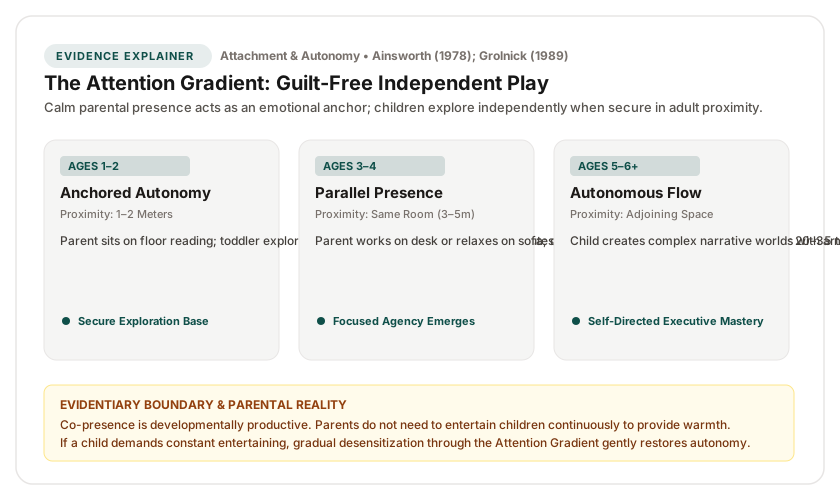
Ainsworth (1978); Grolnick & Ryan (1989): Calm parental presence acts as an emotional anchor; children explore independently when secure in adult proximity.
The Cognitive Gift: Why Independent Play Builds Self-Directed Minds
While stepping back restores the parent's mental well-being, what does it do for the child?
Far from stalling their cognitive progress, independent play provides a neurological workout that adult-directed play can never replicate ``.
In a landmark study published in Frontiers in Psychology, Jane Barker and colleagues at the University of Colorado examined the daily schedules and cognitive profiles of 70 young children ``. The researchers sought to determine how the structure of a child's time influenced their development of self-directed executive function—the capacity to set a goal, formulate a plan, monitor progress, and adjust course without being told what to do by an adult ``.
The empirical findings revealed a stark contrast:
Children who spent greater proportions of their time in less-structured, self-directed play exhibited significantly superior self-directed executive function on standardized cognitive assessments (\beta = 0.28, p < 0.05) ``.
Conversely, children whose days were heavily dominated by adult-structured activities (constant tutoring, organized classes, and continuous adult-directed play) demonstrated lower self-directed executive control ``.
When an Adult Directs the Play:
[Adult Prefrontal Cortex] ──(Plans, Solves, Directs)──> [Child Follows Instructions]
Result: Low cognitive effort for child; cultivates external dependency.
When a Child Plays Independently:
[Child Prefrontal Cortex] ──(Selects Goal, Overcomes Frustration, Adjusts)──> [Success]
Result: High cognitive workout; builds intrinsic self-regulation and grit.
The Prefrontal Shift
Consider what happens when you sit on the floor and take over your child's block tower. When you say, "Let's put the big blue block at the bottom so it doesn't fall, and then add the triangular roof," your mature prefrontal cortex does the heavy lifting ``. You analyzed the physics, planned the sequence, and eliminated the possibility of failure. The child became a passive assistant executing an adult blueprint ``.
When your child plays independently, however, their prefrontal neural circuits are forced into the driver's seat ``:
What should I build? (Initiation and goal setting)
The tall tower wobbles—why did it fall? (Error detection and causal hypothesis testing)
I feel frustrated, but I want to try again. (Inhibitory control and frustration tolerance)
If I use two wide blocks instead, it stays up! (Cognitive flexibility and problem-solving mastery)
In their foundational framework on human motivation, Edward Deci and Richard Ryan established that all human beings possess three innate psychological needs: Autonomy, Competence, and Relatedness ``. When parents constantly orchestrate, supervise, and entertain, they inadvertently rob their children of autonomy and perceived competence ``. Independent play is where children discover that they are capable of entertaining themselves, solving their own boredom, and mastering their physical world ``.
Deconstructing Solitary Play: Why Playing Alone Is Not Being Lonely
One of the deepest sources of parental guilt is the haunting fear that a child playing alone is lonely, sad, or lacking social development.
Developmental psychology decisively refutes this assumption.
In a seminal study published in Developmental Psychology, Robert Coplan and his colleagues investigated solitary behavior in early childhood, establishing a crucial taxonomic distinction between different forms of solitary play ``:
================================================================================
COPLAN ET AL. (2004) TAXONOMY OF SOLITARY BEHAVIOR IN EARLY CHILDHOOD
================================================================================
Solitary Play Category Behavioral Characteristics Developmental Meaning
Solitary-Passive Play: Quiet, constructive engagement Normative, healthy,
with objects, blocks, puzzles, reflects high focus and
art, and books. exploratory stamina.
Solitary-Active / Reticent: Hovering near others without May reflect social
joining; aimless darting; anxiety, fear, or
anxious motor agitation. regulatory distress.
================================================================================
Coplan and his team demonstrated that solitary-passive play—a child deeply engaged in building a Lego structure, arranging animal figurines, or browsing a picture book on their own—is a sign of high cognitive curiosity, attentional maturity, and healthy emotional self-soothing ``. It has zero correlation with social maladjustment or depression ``.
When your child is absorbed in constructive independent play, they are entering a state of creative flow. Hovering over them to interrupt their focus with adult conversation does not enhance their development; it actively shatters their emerging attention span ``.
The "Hovering Trap": The Long-Term Cost of Over-Entertaining
What happens when parents never step back, treating boredom as an emergency that must be instantly remedied?
In an empirical investigation published in the Journal of Child and Family Studies, Holly Schiffrin and colleagues examined the long-term outcomes of hyper-involved "helicopter parenting" ``. Their findings revealed that children raised by parents who continuously micro-managed their activities, solved every minor frustration, and prevented independent struggle exhibited significantly higher rates of anxiety, lower self-efficacy, and reduced life satisfaction as young adults ``.
Parent Treats Boredom as an Emergency ──> Instantly Entertains / Hands Over Screen
[Child Never Experiences the Discomfort of Empty Time]
[Child Never Learns to Self-Initiate, Plan, or Generate Ideas]
[Lifelong Behavioral Dependency, Low Grit & Heightened Anxiety]
Boredom is not a medical emergency; it is nature’s psychological threshold to creative initiative ``. When a child complains, "Mumma, I'm bored!", what they are really experiencing is a temporary lull in external stimulation. If a parent immediately provides an entertainment script or hands over a tablet, the child's internal creative engine is never cranked ``.
Tolerating a child’s brief protest with calm, loving empathy—"It's completely okay to feel bored for a little bit. I wonder what your hands will discover to do today"—allows the child to cross the threshold into self-directed play ``.
The "Yes Space" Architecture: How Physical Design Unlocks Me-Time
If independent play is so developmentally beneficial, why do parents find it so terrifyingly difficult to step back in practice?
The primary barrier in modern Indian flats is not a lack of parental love; it is an environment full of physical friction and adult hazards ``.
In an average 2BHK or 3BHK flat, a parent cannot truly relax because the home is an obstacle course:
Exposed power strips and dangling phone chargers behind the TV unit.
Heavy, sharp-edged glass or marble coffee tables at toddler temple height.
Fragile brass decor, ceramic pots, or important work documents within reach.
Unanchored bookcases that pose catastrophic tip-over risks.
In such an environment, a parent must hover. You cannot drink your chai in peace because your nervous system is in a state of high vigilance, bracing for the crash that demands an emergency hospital run.
================================================================================
PHYSICAL FRICTION VS. "YES SPACE" ARCHITECTURE
================================================================================
Hazardous Flat (High Friction) The "Yes Space" (Zero Friction)
Fragile items, exposed cords, sharp tiles Child-proofed perimeter, enclosed cords
Parent constantly shouts "No! Don't touch!" Parent never has to say "No"
Parent is trapped in hypervigilance Parent can relax nearby with complete peace
Child's autonomy repeatedly thwarted Child explores freely with full agency
================================================================================
Creating the 100% "Yes Space"
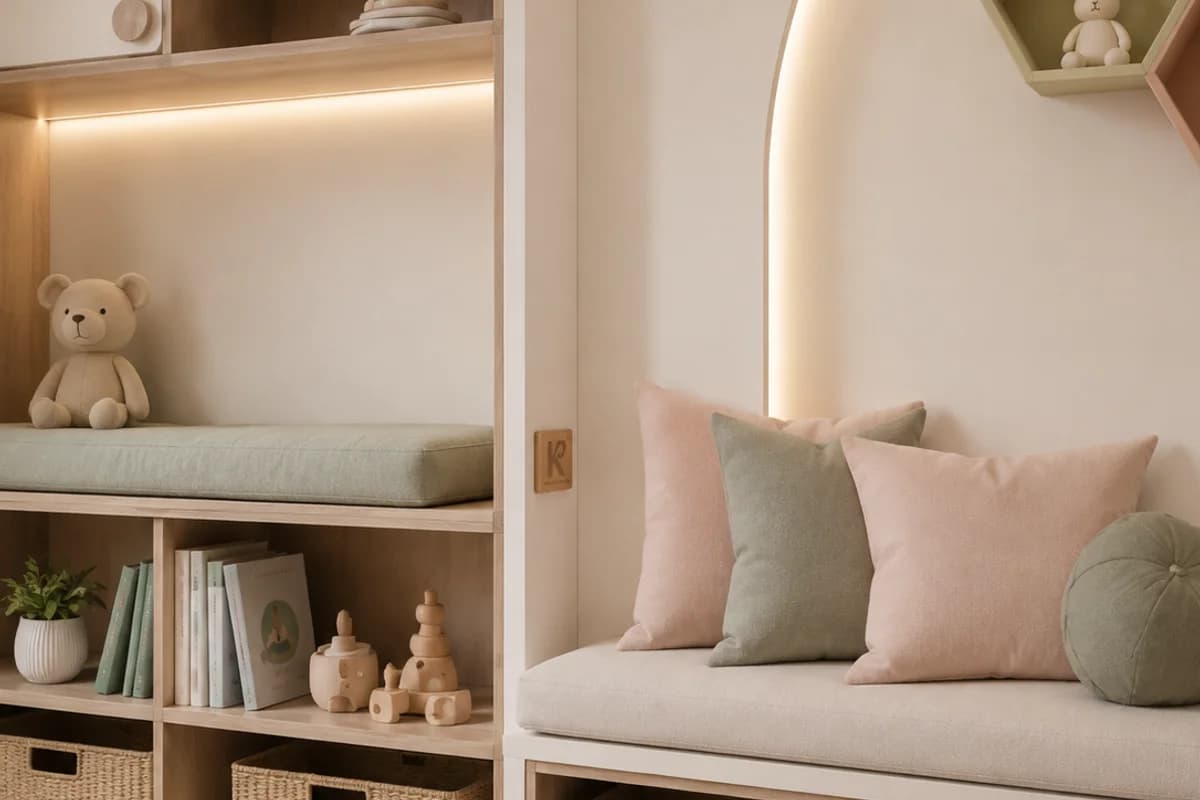
The solution pioneered by pediatrician Emmi Pikler and validated by modern environmental design is the creation of a "Yes Space"—a dedicated, completely child-proofed room or bounded area where everything the child can touch, climb, or open is safe ``:
Mandatory Wall Anchoring (ASTM F2057 Standards): In Indian masonry flats, bolt all shelves, dressers, and storage units into the solid brick or concrete using heavy-duty steel brackets. Eliminate tip-over hazards entirely.
Floor Safety: Place certified non-toxic, impact-attenuating mats (10–15 cm thick) beneath any climbing equipment or balance arches to protect against hard tiles.
The Toy Density Paradox (Dauch et al., 2018): Controlled laboratory experiments prove that toddlers surrounded by 16 toys demonstrate superficial, fragmented play bouts, while toddlers presented with only 4 curated toys engage in significantly longer, deeper, and more sustained independent play ($p < 0.001$) ``. Low toy density is the single greatest physical catalyst for independent play. Place 4 to 6 open-ended items (blocks, silks, animal figurines) on low shelves and store the rest out of sight ``.
The 4-Step Roadmap: From Clingy Attachment to Confident Independence
If your child is accustomed to having you serve as their personal playmate, expecting them to play alone for 45 minutes tomorrow is unrealistic. Independence is a developmental muscle that must be conditioned gradually through a 4-step transition:
================================================================================
THE 4-STEP INDEPENDENT PLAY TRANSITION ROADMAP
================================================================================
Step 1: Fill the Cup First 15 minutes of 100% undivided, phone-free joint
play to satisfy emotional attachment needs.
Step 2: The "Silent Presence" Sit on the rug nearby reading your book;
do not direct, comment, or steer their play.
Step 3: The Scripted Departure Step to the sofa or kitchen within earshot:
"I'm right here chopping carrots if you need me."
Step 4: Supervised Autonomy Child plays deeply for 30–45+ minutes in their
"Yes Space" while you enjoy restorative me-time.
================================================================================
Step 1: Fill the Cup First (The Attachment Foundation)
Children cannot play independently if their emotional attachment tank is empty ``. Begin with 15 minutes of high-quality, undivided, phone-free connection. Sit on the floor, enter their world, and play whatever they choose. Once their need for connection is satisfied, they possess the emotional security required to venture out into independent exploration ``.
Step 2: The "Silent Presence" Bridge
Do not immediately vanish into another room. Transition into a "silent presence." Move from actively playing to sitting on the sofa or a floor cushion nearby with your book or laptop. If your child looks up or hands you a block, acknowledge them with a warm smile and a brief word: "I see your tall red tower, beta. I'm right here reading my book while you build." You remain an emotional anchor without being an active director ``.
Step 3: The Scripted Physical Departure
Once your child is comfortable playing near you, establish physical space with a clear, predictable script: "Mumma is going into the kitchen to prepare evening tea. I will be right there if you need a cuddle, but you can keep working on your puzzle." Never sneak away; sneaking triggers attachment anxiety and clinginess. Stating your location calmly builds trust ``.
Step 4: Expand the Independence Horizon
Start with realistic expectations based on age:
Toddlers (Ages 1.5–2.5): 10 to 15 minutes of independent play is a major victory ``.
Preschoolers (Ages 3–5): 30 to 45 minutes of self-directed play.
Early Primary (Ages 6–8): 60+ minutes of deep project work.
When the play bout concludes, resist the urge to praise the final toy structure with hollow compliments ("Good job!"). Instead, praise their autonomy and process: "You spent thirty minutes building that entire railway all on your own. You looked so focused and proud!" ``.
Summary Matrix: Intensive Entertaining vs. Supported Autonomy
Conclusion: Reclaim Your Chai, Unlock Their Potential
The next time you sink into your sofa with a warm cup of chai while your child plays quietly on the rug, take a slow, deep breath.
Look at the guilt bubbling up in your chest, recognize it for what it is—a cultural myth born of modern anxiety—and gently let it go ``.
You are not ignoring your child. You are not being lazy. You are not failing as a parent.
By stepping back, you are giving your child the greatest developmental gift in the world: the freedom to discover that they are competent, creative, and capable of directing their own mind ``. And by giving yourself permission to rest, you are ensuring that when you do step back into their world, you do so with a full heart, a calm spirit, and the deep, unhurried warmth that your child will cherish for a lifetime ``.
Drink your chai while it is hot. Your child is thriving.
References
Rizzo, K. M., Schiffrin, H. H., & Liss, M. (2013). Insight into the motherhood mystique: The role of intensive mothering beliefs and maternal health. Journal of Child and Family Studies, 22(5), 614–625. DOI: 10.1007/s10826-012-9615-z
Mikolajczak, M., Gross, J. J., & Roskam, I. (2019). Parental burnout: What is it, and why does it matter? Clinical Psychological Science, 7(6), 1319–1329. DOI: 10.1177/2167702619858430
Barker, J. E., Semenov, A. D., Michaelson, L., Provan, L. S., Anderson, C. Y., & Munakata, Y. (2014). Less-structured time in children's daily lives predicts self-directed executive function. Frontiers in Psychology, 5, 593. DOI: 10.3389/fpsyg.2014.00593
Coplan, R. J., Prakash, K., O'Neil, K., & Armer, M. (2004). Do you "want" to play? Distinguishing between conflicted shyness and social disinterest in early childhood. Developmental Psychology, 40(2), 244–258. DOI: 10.1037/0012-1649.40.2.244
Ryan, R. M., & Deci, E. L. (2000). Self-determination theory and the facilitation of intrinsic motivation, social development, and well-being. American Psychologist, 55(1), 68–78. DOI: 10.1037/0003-066X.55.1.68
Schiffrin, H. H., Liss, M., Miles-McLean, H., Geary, K. A., Erchull, M. J., & Tashner, T. (2014). Helping or hovering? The effects of helicopter parenting on college students' well-being. Journal of Child and Family Studies, 23(3), 548–557. DOI: 10.1007/s10826-013-9716-3
Yogman, M., Garner, A., Hutchinson, J., Hirsh-Pasek, K., Golinkoff, R. M., & AAP Committee on Psychosocial Aspects of Child and Family Health (2018). The power of play: A pediatric role in enhancing development in young children. Pediatrics, 142(3), e20182058. DOI: 10.1542/peds.2018-2058
Dauch, C., Imwalle, M., Ocasio, B., & Metz, A. E. (2018). The influence of the number of toys in the environment on toddlers' play. Infant Behavior and Development, 50, 78–87. DOI: 10.1016/j.infbeh.2017.11.005
Parenting is not a performance art. When we step back with confidence, we give our children the space to discover who they are when no one is directing them.
Related to this topic
Designing a space for play, movement and learning?
Kubeplay's interior-design services cover children's bedrooms, playrooms and study spaces.
Explore Kubeplay children's-space servicesFurniture ideas for the room
Explore category guidance and bespoke design options. Individual product availability is confirmed separately.