


Beyond IQ: Why Early Emotional Competence Predicts Lifelong Adjustment
In urban Indian households, parental attention is often intensely focused on early cognitive markers: how early a child recites the English alphabet, memorises phonics, or counts to one hundred.
Yet longitudinal developmental research reveals that cognitive metrics in preschool are poor predictors of whether a child will thrive socially and academically in school.
In a landmark longitudinal cohort study published in Child Development, Susanne Denham and colleagues tracked 143 preschool children across ages 3, 4, and into kindergarten to evaluate the trajectory of early social-emotional skills ``. The researchers measured three specific pillars of emotional competence:
Emotion Knowledge: The child’s ability to correctly identify and name basic facial expressions and emotional vignettes.
Emotion Regulation: How effectively the child managed frustration and down-regulated intense autonomic arousal.
Affective Expression: The balance of positive versus negative emotional outbursts during peer interactions ``.
The empirical findings were striking: early emotional competence at ages 3 and 4 was a powerful, statistically significant predictor of kindergarten peer acceptance, positive teacher relationships, and successful classroom adjustment (\beta = 0.35, p < 0.001) ``. Children who entered formal schooling with low emotional recognition and poor regulatory stamina exhibited significantly higher rates of peer rejection, behavioral aggression, and academic withdrawal ``.
================================================================================
DENHAM ET AL. (2003) LONGITUDINAL FINDINGS: PRESCHOOL TO KINDERGARTEN
================================================================================
Preschool Emotional Competence (Ages 3–4) Kindergarten Outcomes
High Emotion Knowledge & Regulation ───────> Superior Peer Acceptance (p < 0.001)
───────> Warm Teacher Engagement (p < 0.001)
───────> Resilient Academic Adjustment
Low Emotion Knowledge & Regulation ───────> Heightened Peer Rejection
───────> Externalizing Aggressive Outbursts
───────> Classroom Disengagement & Frustration
================================================================================
A child can know the names of all the planets, but if they fall apart into an uncontrollable rage when another child takes the red crayon, or cannot read the subtle look of discomfort on a classmate's face, their academic journey will be fraught with friction ``. Emotional intelligence is the master operating system upon which cognitive learning operates ``.
The Imagination Lab: How Pretend Play Builds Perspective-Taking
Between the ages of 3 and 5, human children experience a profound cognitive revolution known as Theory of Mind (ToM)—the realization that other people possess private thoughts, desires, perspectives, and emotional worlds distinct from their own ``.
How does an egocentric toddler, who naturally believes the entire universe revolves around their immediate wishes, learn to inhabit someone else's emotional reality?
They do it through socio-dramatic pretend play ``.
In an observational study published in Early Childhood Research Quarterly, Eric Lindsey and Malinda Colwell investigated the link between different play modalities and affective competence in preschoolers ``. Their findings revealed that children who engaged frequently in complex, reciprocal pretend play demonstrated significantly higher scores in affective perspective-taking (r = 0.32, p < 0.01) ``.
Child Enters Pretend Role (e.g., Doctor, Mama, Wounded Animal)
[Must Step Outside Egocentric Perspective to Maintain Narrative]
[Mentally Simulates Partner's Distinct Emotional Needs & Script]
[Neurodevelopmental Maturation of Affective Theory of Mind (ToM)]
When two children play "hospital" or "kitchen," they are conducting advanced mental gymnastics ``. To keep the game alive, the child playing the "doctor" cannot act purely on impulse. They must ask: "How does my patient feel? They are scared of the injection, so I must speak gently." If the "patient" suddenly decides they want to be a roaring lion, the "doctor" must negotiate: "Wait, can the lion have a hurt paw?"
This continuous, reciprocal negotiation forces children to mentally simulate another person's emotional state ``.
The Scientific Boundary: The Lillard Equifinality Principle
It is vital, however, to avoid commercial overclaiming. In an exhaustive review published in Psychological Bulletin, Angeline Lillard and colleagues examined the methodology of pretend play research ``. They demonstrated that pretend play does not operate as an isolated, mechanical cause of empathy in a vacuum ``.
Instead, pretend play is an equifinal rehearsal laboratory ``. Children take the social concepts, emotional vocabularies, and moral narratives they observe in their human relationships and use dramatic play as a safe staging ground to test, practice, and refine them ``. Buying an elaborate dress-up costume will not independently raise a child's EQ; rather, it is the interactive, human dialogue that occurs during imaginative play that embeds social competence ``.
Pretend Play & Emotional Self-Regulation
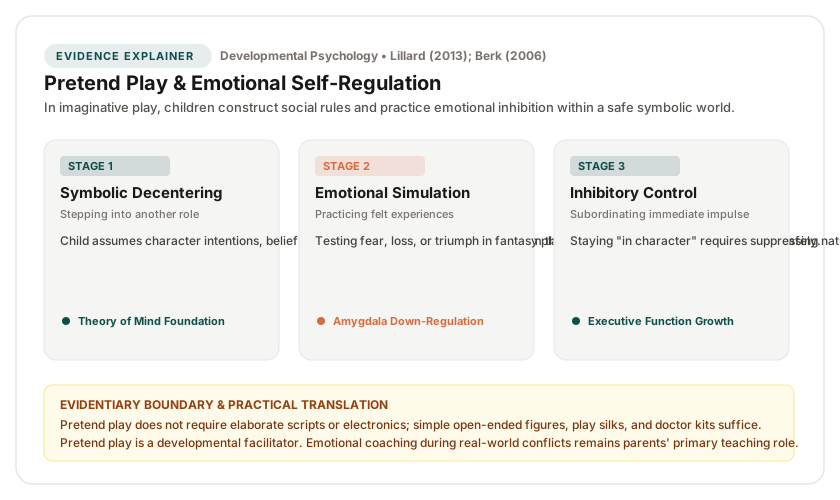
Lillard et al. (2013); Berk et al. (2006): Stepping into another character's role provides safe practice for cognitive de-centering and prefrontal emotional braking.
The Brain’s Emergency Brakes: The Surprising Science of Rough-and-Tumble Play
In many Indian apartment complexes, physical roughhousing—wrestling on the bed, chasing, tickle wars, and tumbling—is met with immediate adult panic: "Stop it right now! Someone is going to get hurt! Don't be so aggressive!"
Yet developmental neurobiology and comparative behavioral science reveal that regulated physical rough-and-tumble play (RTP) is one of the most sophisticated emotional training grounds in the natural world ``.
In a pivotal observational study published in the Journal of Family Psychology, John Flanders and colleagues observed fathers engaging in physical rough-and-tumble play with their young children ``. The researchers discovered a critical scientific distinction between regulated and unregulated physical play:
================================================================================
FLANDERS ET AL. (2009) ROUGH-AND-TUMBLE PLAY (RTP) STUDY FINDINGS
================================================================================
Type of Physical Play Adult Behavioral Rule Child Emotional Outcome
Regulated RTP: Enforces firm boundaries, Superior self-regulation;
pauses during high arousal, Significantly lower aggression
models self-handicapping. in school (p < 0.05).
Unregulated RTP: No stopping cues enforced, Heightened dysregulation;
allows chaotic escalation Increased externalizing
into genuine anger. aggression outside home.
================================================================================
The Neurobiology of the "Emotional Brake"
Why does regulated wrestling teach emotional control?
During vigorous physical roughhousing, a child’s sympathetic nervous system spikes: heart rate accelerates, motor excitement surges, and adrenaline rises ``. In essence, they are experiencing the exact physiological arousal of rage or terror, but within a joyous, cooperative context ``.
When an adult introduces a sudden boundary—such as calling "Freeze!" or pausing the match when a blow is struck too hard—the child is forced to instantly fire their prefrontal inhibitory control circuits ``. They must slam on their neurodevelopmental emotional brakes while operating at peak autonomic arousal ``.
Sergio and Vivien Pellis, leading neuroscientists in juvenile play behavior, have demonstrated that this reciprocal physical calibration teaches self-handicapping—the conscious modulation of force to keep a play partner safe and engaged ``. Children who are given regular, regulated opportunities to wrestle within loving boundaries learn where their bodies end and others begin. They master the ability to transition smoothly from explosive excitement back to calm self-control ``.
> The Parental Golden Rule: Do not ban physical roughhousing; regulate it. Establish a non-negotiable safe word (like "Red Light" or "Pause"), demand immediate freezes, and never tolerate play that crosses into real pain ``.
Monsters, Battles, and Villains: Decoding "Aggressive" Pretend Play
Every parent has experienced a moment of quiet dread while watching their young child play. Your gentle four-year-old is suddenly roaring like a tyrannosaur, gleefully announcing that they are "eating the baby's head," or repeatedly crashing two superhero action figures together while shouting about destruction.
The modern parental reflex is often to intervene with alarm: "No hitting! Be gentle! Why are you playing so violently?"
Yet in their seminal research at the Yale Imagination Center, Dorothy and Jerome Singer revealed that dramatic conflict, villain roles, and symbolic destruction are entirely normal and developmentally essential aspects of childhood play ``.
Real-World Child Experience: Small, Vulnerable, Powerless, Subject to Adult Rules
[Internalization of Anxiety, Frustration & Latent Fear]
[Dramatic Symbolic Play: Enacting Monsters, Superheroes & Rescues]
[Safe Externalization, Mastery & Neurobiological Catharsis]
To be a young child is to experience pervasive powerlessness ``. You are physically small, your daily schedule is dictated entirely by adults, and you are surrounded by a vast, incomprehensible world filled with scary real-world concepts (illness, monsters under the bed, thunder, parental frustration) ``.
When a child enacts a dramatic battle between toys:
They project their unmanageable anxieties onto symbolic inanimate avatars ``.
As the "monster" or the "superhero," they hold absolute power and control ``.
They safely experiment with danger, aggression, and rescue without real-world consequences ``.
Clinical guidance published by the American Academy of Pediatrics emphasizes that pretend play acts as an emotional buffer against toxic stress ``. Stifling a child’s dramatic play scripts deprives them of a vital psychological outlet. Unless the aggression is spilling into real-world harm toward peers or pets, parents should view dramatic villain play not as a moral defect, but as the healthy processing of an active imagination ``.
The Emotion-Coaching Parent: Becoming a Play Partner, Not a Director
In their foundational framework on parental emotion socialization published in Psychological Inquiry, Nancy Eisenberg and colleagues identified how parental reactions to children's feelings fundamentally shape emotional agility ``. They contrasted three primary parenting stances:
The Dismissing Stance: Minimizing or invalidating emotions ("Stop crying, it's nothing").
The Punitive Stance: Threatening punishment for emotional distress ("If you don't stop this tantrum right now, you're going to your room").
The Emotion-Coaching Stance: Viewing emotional storms as opportunities for intimacy and teaching ``.
================================================================================
PARENTAL ROLES IN EVERYDAY EMOTIONAL PLAY
================================================================================
Ineffective: The Play Dictator Effective: The Emotion-Coaching Partner
Hijacks the script with moral lectures Follows the child's narrative lead
Corrects "unrealistic" pretend scenarios Accepts fantasy without judgment
Shames pretend aggression or crying Gently mirrors and labels emotional cues
Insists on rigid adult logic Provides responsive, warm scaffolding
================================================================================
When parents enter their child's play world, they often make the mistake of becoming the "Play Dictator"—correcting imaginary logic ("Cars don't fly!") or using the game to deliver heavy-handed moral lessons ``.
True emotion coaching in play requires stepping into the child's narrative as an equal or subordinate character while acting as a gentle emotional mirror ``:
Label the Avatar's Feelings: Instead of analyzing your child, reflect the toy’s emotion: "Oh, look at the baby bear. He looks really worried that his mother left him behind in the cave. I wonder what he needs to feel safe?" ``.
Model Vulnerability: Play the clumsy, scared, or uncertain character: "I’m a very timid knight! The dragon looks terrifying. Can you hold my hand while we walk past?" This gives your child the exhilarating experience of being the protector and leader ``.
Validate Resolution: Allow the narrative to reach a comforting conclusion before ending the game: "The dragon was just lonely, wasn't he? Now they're sharing soup."
Designing an Emotional-Intelligence Playground at Home: 4 Spaces for Indian Flats
Supporting emotional development does not require converting your apartment into a daycare center. By dedicating small, intentional zones within your 2BHK or 3BHK flat, you can create a physical environment that naturally scaffolds emotional intelligence:
================================================================================
THE EMOTION-INTELLIGENCE APARTMENT BLUEPRINT
================================================================================
The Dramatic Imagination Nook A low basket of open-ended props, silks,
and puppets for perspective-taking scripts.
The Impact-Protected Mat Zone Certified 10–15 cm dual-density foam mat
for safe rough-and-tumble emotional brakes.
The Voluntary Calm-Down Corner A cozy sensory nook (floor cushions, weighted
pad, feelings books) for self-soothing.
The Expression Art Station Low drawing table with crayons and blank paper
to externalize complex non-verbal feelings.
================================================================================
1. The Dramatic Imagination Nook (Perspective-Taking Station)
Dedicate a low, open wicker basket or open shelf to open-ended dramatic props ``. Avoid hyper-specific plastic costumes with pre-moulded sounds. Instead, provide:
Simple fabric silks, scarves, and old adult shirts that can become doctor's coats, superhero capes, or picnic blankets.
2 or 3 animal hand puppets or soft dolls.
Wooden play kitchen utensils or miniature medical props.
These open-ended materials force the child to generate their own communicative scripts, accelerating theory-of-mind development ``.
2. The Impact-Protected Wrestling Mat (Emotional Brake Arena)
To practice rough-and-tumble play without the risk of skull fractures or broken bones on Indian hard marble and vitrified tiles, invest in a certified, dual-density impact foam mat (10 to 15 cm thick, compliant with EN 1176 / ASTM F1292 impact-attenuation standards) ``.
This mat creates a clear physical boundary: roughhousing happens only on the mat. When a child steps off, the wrestling pauses. This physical boundary reinforces the mental discipline of self-regulation ``.
3. The Calm-Down Corner (Voluntary Self-Soothing Sanctuary)
A Calm-Down Corner is not a punitive time-out spot ``. It is an inviting, quiet sanctuary where a child can retreat when overwhelmed:
Place a plush floor cushion or beanbag inside a low teepee or between two bookshelves.
Include tactile sensory items: a soft fleece blanket, a weighted lap pad, a sensory glitter jar, and picture books about feelings (e.g., The Color Monster or When Sophie Gets Angry).
Teach your child when they are calm: "When big feelings make your body feel hot or buzzy, you can always come sit with your soft cushion until your heart feels slow again." ``.
4. The Expression Art Station
When children lack the linguistic vocabulary to explain grief, jealousy, or rage, drawing provides a non-verbal emotional bridge ``. Provide a child-height table equipped with non-toxic beeswax crayons, thick paper, and modeling clay. When your child is upset, invite them to draw their feeling: "Can you show me what your anger looks like on this paper? What color is it?"
Summary Matrix: Play Modalities and Emotional Competence
Conclusion: The Gift of Emotional Literacy
The next time your child dissolves into tears over a snapped biscuit, or crashes into your legs begging for an impromptu wrestling match, pause and shift your lens.
They are not attempting to manipulate you, nor are they exhibiting behavioral defiance ``. They are immature human beings wrestling with intense biological currents that their developing nervous systems are only beginning to comprehend ``.
You do not need to buy expensive emotional curricula or enroll your four-year-old in social-skills coaching classes. Everything your child needs to become an emotionally agile, deeply empathetic, and resilient human being is already hardwired into their instinct for everyday play ``.
When you make space on the living room rug for a costume basket, when you roll onto an impact mat for a giggling, regulated wrestling match, and when you sit beside them as a supportive play partner, you are building the neurological architecture of emotional resilience ``. You are giving your child the greatest emotional anchor of all: the knowledge that all feelings are welcome, that self-control can be practiced with joy, and that they are deeply loved through every storm.
References
Denham, S. A., Blair, K. A., DeMulder, E., Levitas, J., Sawyer, K., Auerbach-Major, S., & Queenan, P. (2003). Preschool emotional competence: Pathway to social competence. Child Development, 74(1), 238–256. DOI: 10.1111/1467-8624.00533
Lillard, A. S., Lerner, M. D., Hopkins, E. J., Dore, R. A., Smith, E. D., & Palmquist, C. M. (2013). The impact of pretend play on children's development: A review of the evidence. Psychological Bulletin, 139(1), 1–34. DOI: 10.1037/a0029321
Lindsey, E. W., & Colwell, M. J. (2013). Pretend and physical play: Links to preschoolers' affective social competence. Early Childhood Research Quarterly, 28(4), 746–756. DOI: 10.1016/j.ecresq.2013.07.002
Flanders, J. L., Leo, V., Paquette, D., Pihl, R. O., & Séguin, J. R. (2009). Rough-and-tumble play and the regulation of aggression: An observational study of father-child play. Journal of Family Psychology, 23(2), 285–295. DOI: 10.1037/a0015248
Eisenberg, N., Cumberland, A., & Spinrad, T. L. (1998). Parental socialization of emotion. Psychological Inquiry, 9(4), 241–273. DOI: 10.1207/s15327965pli0904_1
Yogman, M., Garner, A., Hutchinson, J., Hirsh-Pasek, K., Golinkoff, R. M., & AAP Committee on Psychosocial Aspects of Child and Family Health (2018). The power of play: A pediatric role in enhancing development in young children. Pediatrics, 142(3), e20182058. DOI: 10.1542/peds.2018-2058
Singer, D. G., & Singer, J. L. (2005). Imagination and Play in the Electronic Age. Harvard University Press, Cambridge, MA. ISBN: `978-0674017078`.
Pellis, S. M., & Pellis, V. C. (2007). Rough-and-tumble play and the development of the social brain. Current Directions in Psychological Science, 16(2), 95–98. DOI: 10.1111/j.1467-8721.2007.00483.x
Children do not experience emotions in abstract words; they experience them in their bodies. Play is the translator that turns big feelings into lifelong emotional strength.
Related to this topic
Designing a space for play, movement and learning?
Kubeplay's interior-design services cover children's bedrooms, playrooms and study spaces.
Explore Kubeplay children's-space servicesFurniture ideas for the room
Explore category guidance and bespoke design options. Individual product availability is confirmed separately.